Back to blog
Back to Case Studies
A Smarter SKU Rationalization Workflow
.png)

SKU Rationalization with Lumi AI
Assortments grow over time. New launches are added, regional preferences shift, promotional items come and go, and store formats evolve. Before long, merchandising teams are managing hundreds or thousands of SKUs that do not all contribute equally to sales, margin, basket size, or customer experience.
SKU rationalization helps teams identify which items should be protected, reviewed, or potentially removed from the assortment. But the challenge is that low standalone performance does not always mean an item should be delisted. Some products may appear weak on their own while still helping drive larger baskets, higher gross profit, or stronger category penetration.
In this guide, we walk through Lumi’s approach to SKU rationalization: a workflow that helps merchandising and category teams protect basket-driving SKUs, rank rationalization candidates, and quantify the upside of a more productive assortment.
What is SKU Rationalization?
SKU rationalization is the process of evaluating an assortment to determine which items should remain active, which should be reviewed, and which may be candidates for delisting or reduced distribution.
A strong SKU rationalization process helps teams:
- Reduce assortment clutter and slow-moving inventory.
- Free up working capital tied to underperforming SKUs.
- Improve shelf productivity by reallocating space to stronger items.
- Protect products that drive baskets even if their own sales are modest.
- Create consistent, data-backed rules for assortment decisions across regions, categories, stores, and formats.
The goal is not simply to cut the bottom 10% of SKUs. The goal is to make smarter assortment decisions by understanding both standalone item performance and the role each item plays in the broader basket.
SKU Rationalization with Lumi AI
Lumi makes SKU rationalization more actionable by helping teams move from broad assortment questions to specific, defensible item-level recommendations. Here is a step-by-step workflow.
1. Choose the right level of analysis
Start by defining the business scope.
For example, a team may want to analyze:
A specific market, region, or business unitA department or category groupA product category or subcategoryIndividual stores, store clusters, or store formats
This step matters because SKU performance is rarely uniform. An item may be weak across the full business but valuable in a specific store format, channel, or customer segment. Another item may look healthy at a total-category level but underperform in certain locations.
With Lumi, teams can ask questions such as:
“Show me SKU rationalization candidates by category, store format, and product group.”
or:
“Which items are consistently weak across the business versus only weak in specific stores or channels?”
The output can support two types of decisions:
Broad assortment rationalization: items that appear weak across a market, category, or business unit.
Localized rationalization: items that may only be weak in specific stores, formats, clusters, or channels.
This gives teams the flexibility to avoid one-size-fits-all delisting decisions.
2. Identify high-halo items before cutting
Before building a rationalization list, Lumi helps identify SKUs that may have a “halo” effect.
A halo item is a product that may not look strong on its own but appears in baskets that perform well. For example, a niche dairy item may have low sales volume, but customers who buy it may also purchase higher-value or higher-margin products in the same trip.
This step is critical because removing the wrong SKU can shrink the basket.
Lumi’s approach evaluates each item by looking at the baskets that contain it, while excluding the item’s own line from the calculation. For each item, Lumi can calculate basket-level metrics such as:
- Gross profit
- Sales
- Penetration
Those values are then averaged across baskets and compared with the material group median. If an item exceeds the material group median on any one of the selected metrics, it can be flagged as a halo candidate.
This “OR condition” is intentionally protective. Early in the process, the goal is to avoid accidentally cutting items that may be important basket drivers. Over time, once the business builds trust in the framework, the logic can evolve toward stricter criteria.
Lumi can bucket items into:
High Halo: protect from rationalization.
Not Halo: eligible for further ranking.
Insufficient Data: send to manual review instead of auto-cutting.
Significance gates, such as minimum basket count, help ensure the halo signal is based on enough transaction history to be useful.
.png)
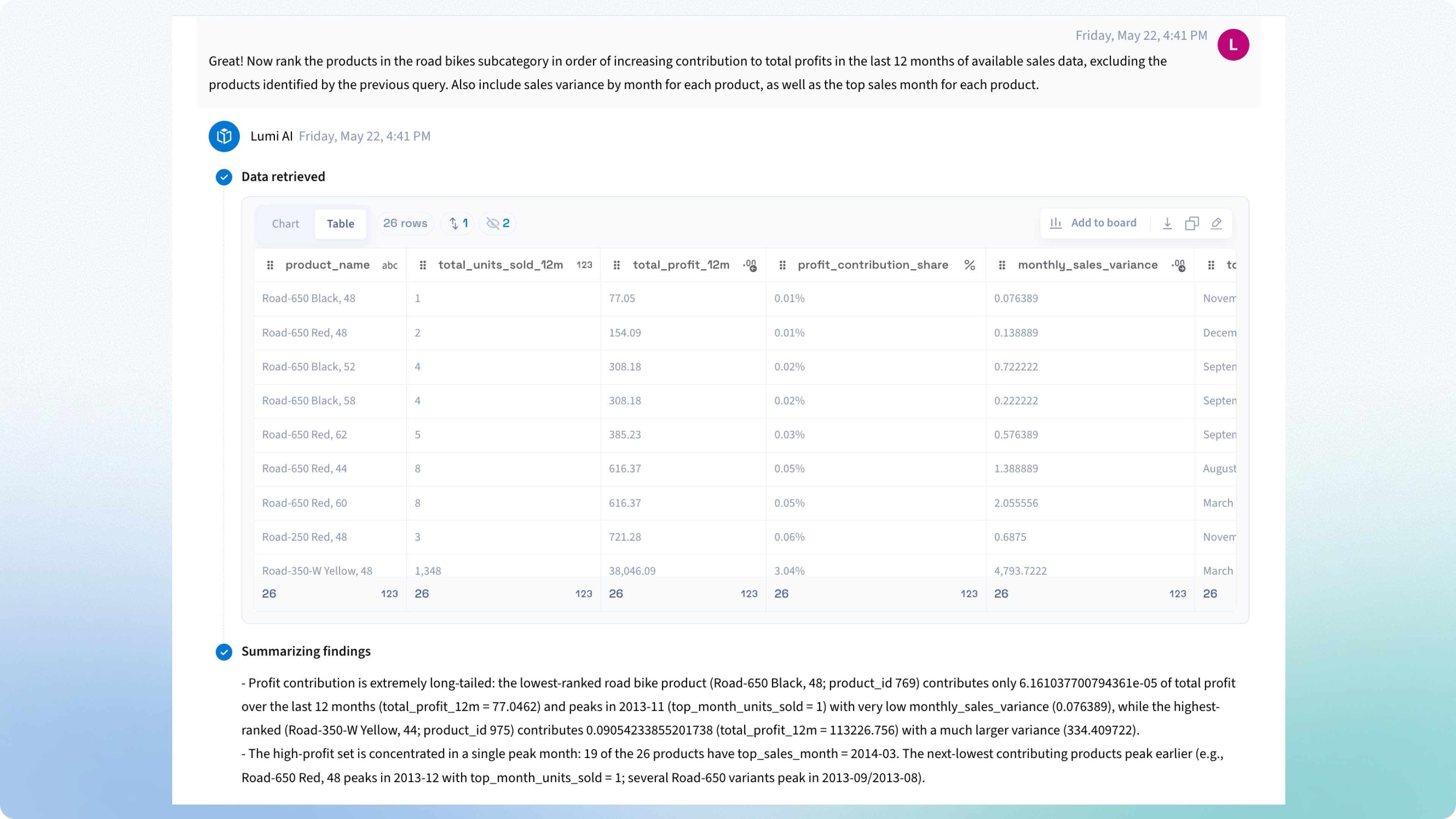
3. Rank the remaining SKUs using a balanced composite score
Once high-halo items are protected, Lumi helps isolate the rationalization list.
Rather than ranking SKUs on a single metric, users can rank items based on a balanced view of performance. This can include measures such as sales, penetration, margin contribution, inventory productivity, or other business-relevant KPIs depending on data availability and category priorities.
This approach reflects a practical reality: no single metric tells the full story. A SKU with low margin may still have strong customer penetration. Another SKU may sell frequently but contribute little economically. A third may appear weak because of data quality, inventory availability, or recent launch timing.
Lumi can apply business rules and exclusions such as:
- Excluding high-halo items identified in the previous step.
- Accounting for recently introduced products that have not had enough time to mature.
- Flagging items with limited or incomplete data for review rather than automatic action.
This creates a more defensible candidate list. The output is not simply “the lowest-performing SKUs.” It is a ranked view of items that underperform after accounting for basket role, commercial contribution, customer behavior, and business context.
4. Add decision tags for smarter review
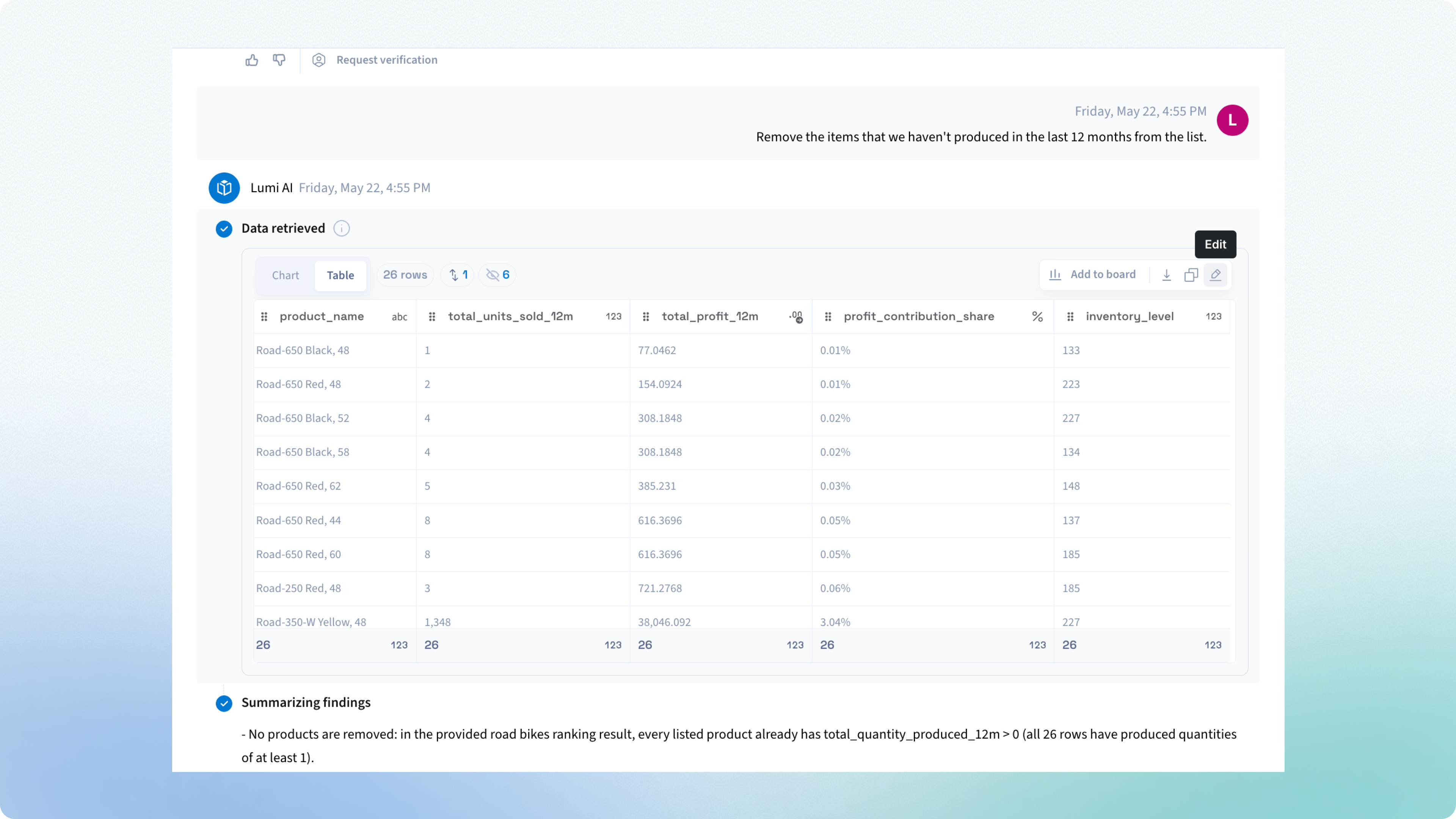
Not every weak item should be treated the same way. Lumi can add informational tags to help teams understand why an item appears on the rationalization list.
Examples include:
Zero inventory: the item may look weak because it has not been available, so this should be treated as a potential supply chain issue rather than an automatic delist.
Seasonal: demand may be concentrated in specific months or occasions.
Promotional: performance may depend heavily on promotional lift.
These tags help category teams move faster without losing context. Instead of spending time manually investigating every SKU, teams can focus on the items where the recommendation requires judgment.
5. Calibrate cut depth by material group contribution
SKU rationalization should not apply the same cut depth everywhere.
Some categories or product groups may require a more conservative approach because they are strategically important, highly visible to customers, or central to the shopping mission. Others may support a deeper review because they have long tails, overlapping items, or lower contribution relative to the complexity they create.
Lumi can help teams compare product groups and calibrate rationalization depth based on business context. Rather than using a fixed rule across the full assortment, teams can evaluate where a lighter touch is appropriate and where a more aggressive review may be justified.
This creates a more nuanced process than a flat category-wide cut. It also helps merchandising teams defend their decisions by showing that the recommendation is tied to contribution, customer behavior, and assortment role—not just SKU count reduction.
How Lumi AI Helps Teams Access the Output
The rationalization workflow can be delivered in several formats depending on how the team works.
Lumi can support:
- Pre-built boards with drilldowns.
- Curated prompts for category managers and merchants.
- CSV or Excel exports for offline review.
- Region-level lists for broad assortment decisions.
- Store-level lists for localized optimization.
This allows teams to move from analysis to decision-making without rebuilding the logic each time.
Quantifying the Benefit of SKU Rationalization
The value of SKU rationalization comes from more than removing slow movers. Lumi’s approach helps quantify benefit across three layers.
1. Direct cost-out
The first layer is the inventory and capital released by reducing or delisting selected SKUs.
This can include:
- Inventory holding cost avoided.
- Working capital released from carrying stock.
- Shelf space freed for better use.
This is often the most defensible benefit layer because it is tied directly to inventory value and cost of capital.
2. Gross profit recovery
The second layer is the upside from reallocating shelf space to better-performing SKUs.
For example, teams can estimate the gross profit potential of giving freed facings to higher-productivity items, then subtract the gross profit contribution lost from delisted SKUs.
This is where much of the value may live, especially when assortment space can be shifted toward top-quartile performers.
3. Basket protection
The third layer is the value preserved by not cutting halo items.
This is the key difference between a naive tail-cutting exercise and a Lumi-enabled SKU rationalization process. By identifying basket-driving items before finalizing the rationalization list, teams can reduce the risk of removing products that support larger or more profitable baskets.
Why SKU Rationalization Matters
SKU rationalization is often treated as a periodic cleanup exercise. But when done well, it becomes a strategic assortment capability.
It helps teams answer questions like:
- Which SKUs are truly underperforming?
- Which items look weak but support strong baskets?
- Which material groups can support deeper cuts?
- Which items should be reviewed because of seasonality, promotions, or inventory gaps?
- How much value can be unlocked through inventory reduction, shelf reallocation, and basket protection?
With Lumi, organizations can bring these questions into a single analysis workflow. Teams can start with a natural-language prompt, apply consistent business logic, drill into exceptions, and produce a ranked candidate list that is easier to defend.
The result is a smarter assortment: fewer low-value SKUs, better use of space and capital, and stronger protection for the items that matter to the basket.
Frequently Asked Questions
Q1: What data is required for SKU rationalization in Lumi AI?
At minimum, teams need item-level sales, gross profit or margin proxy, transaction penetration, product hierarchy, store or region data, inventory status, and item introduction dates. Basket-level transaction data is needed to calculate halo effects.
Q2: How does Lumi AI identify a halo item?
Lumi evaluates the baskets that contain each item, excluding the item itself from the calculation. It then compares basket-level performance against the relevant material group median. If the item’s associated baskets outperform the median on sales, gross profit, or penetration, the item can be flagged as a halo candidate.
Q3: Why not just delist the lowest gross profit SKUs?
Gross profit alone can miss important context. Some items may have low standalone contribution but help drive larger baskets. Others may appear weak because they are seasonal, out of stock, or promotion-dependent. Lumi adds these signals before recommending rationalization candidates.
Q4: How aggressive should the cut depth be?
Rationalization depth should depend on the category, product group, store format, and business objective. Lumi can help teams identify where a conservative review is appropriate and where a deeper review may be justified, rather than applying one fixed target across the full assortment.
Q5: What happens to items with insufficient data?
Items with insufficient data should not be automatically cut. Lumi can flag them for manual review so teams can apply business judgment before making assortment decisions.
Q6: Can Lumi support both region-level and store-level rationalization?
Yes. Lumi can generate a region-level view for items that underperform broadly, as well as store-level views for localized assortment decisions. This helps teams avoid cutting an item everywhere when the issue may only exist in certain stores or formats.
Find Hidden Value in Your Assortment Data
SKU rationalization is not just about reducing item count. It is about making better assortment decisions with the right balance of performance, customer behavior, basket impact, and business context.
Lumi AI helps teams identify what to cut, what to protect, and where the value lives.

Make Better, Faster Decisions.
.png)
.avif)
.avif)

Join Our Newsletter
Subscribe for the latest on self-service analytics, AI, and data-driven transformations.