AI & Analytics
From Postgres to Insights: Connecting AI for Smarter Decisions
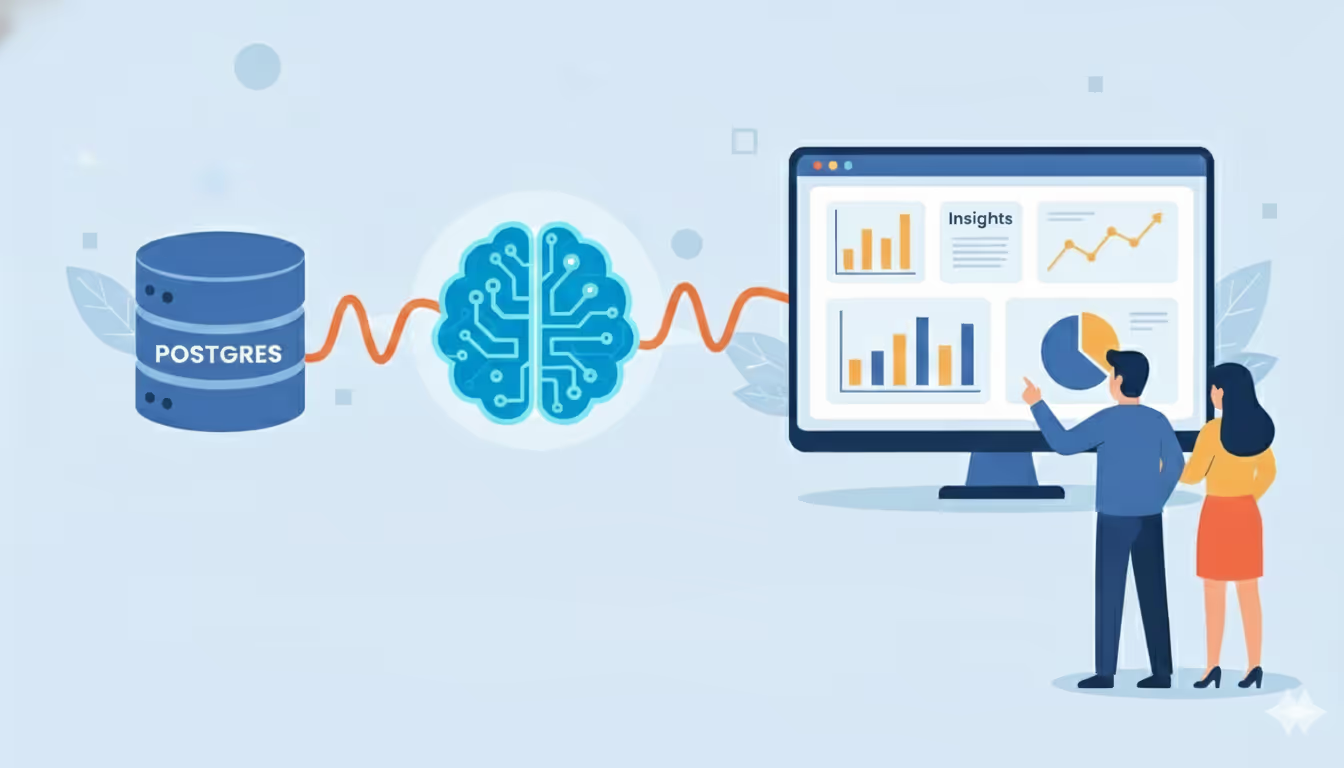
Every organization with a Postgres database faces the same frustrating reality: your data is technically available, but it's not accessible. Business users have questions that could drive better decisions, yet those questions sit in a queue for days or weeks. Data teams spend months building ETL pipelines, defining semantic layers, and constructing dashboards before anyone can extract a single insight. During this time, opportunities slip away and problems go undetected.
The traditional path from raw database to actionable intelligence doesn't have to take months anymore. Modern AI-powered analytics platforms can connect directly to Postgres and start delivering insights within daysb y acting as a semantic bridge between technical database structures and business language. AI eliminates the engineering bottleneck that has defined enterprise analytics for decades. This article explores how this transformation happens and what it means for organizations ready to accelerate their decision-making.
Why Organizations Wait Months for Data Insights
The journey from raw Postgres data to business insights traditionally involves a complex, time-consuming process that most organizations accept as unavoidable. Understanding these bottlenecks reveals why the AI-native approach represents such a significant shift.
The Technical Barrier
When data teams connect a Postgres database to an analytics workflow, they face a horrifying engineering challenge. They must extract and clean raw tables, dealing with inconsistent formats, missing values, and data quality issues. Next comes building relationships and joins between entities, mapping how customers connect to orders, how products link to inventory, and how transactions relate to financial records.
But the most time-intensive task is constructing the semantic layer. A semantic layer translates technical data structures into everyday language. Database fields like NO_, CUST_ID, or ORD_STS mean nothing to business users. Data engineers must translate these cryptic names into meaningful business terms: Item Number, Customer Identifier, Order Status. They define metrics, create calculations, and establish the business logic that determines how "revenue" differs from "gross revenue" or how "active customers" get counted.
Only after this foundation is complete can teams build BI models and dashboards. This entire process typically consumes weeks or months, depending on data complexity and team size. According to industry research, analyses requiring data team support often take seven days or longer to complete, even for straightforward questions.
The Access Gap
During this state most operational data is inaccessible to business users, besides submiting adhoc requests. Business users who need answers, like supply chain managers wondering about stockout patterns or sales directors investigating regional performance dips, must submit requests and wait. Ad-hoc questions, the kind that drive real-time decision-making, simply go unanswered because the technical barrier is too high.
This creates a fundamental disconnect: the people who understand the business context can't access the data, while the people who can query the database don't have the business context to ask the right questions. Data becomes a bottleneck rather than an accelerator, with business users dependent on overworked data teams for every analytical need.
How AI Transforms Database Connectivity
Generative AI acts as an intelligent intermediary between raw database structures and human questions. Instead of requiring months of upfront engineering, AI-powered platforms connect to databases and immediately begin translating natural language queries into executable SQL.
The Semantic Bridge Concept
AI platforms connect directly to your Postgres environment and use intelligent schema understanding to interpret database structures on the fly. When a table contains a field named NO_, the system allows you to rename it directly within a Knowledge Base, mapping it to "Item ID."
The AI reads table structures, infers relationships based on naming conventions, and builds a lightweight semantic layer without manual data modeling. Business users can immediately start asking questions while data teams refine the structure over time.
Building the Knowledge Base
The Knowledge Base serves as the foundation for AI-powered analytics. Once connected to Postgres, teams can:
- Import all tables and fields into the workspace
- Define relationships between entities with visual tools
- Rename fields to align with business terminology
- Add metadata like descriptions or measurement units
This creates a reporting layer directly on top of the relational database, eliminating separate data warehouses or complex BI tools for initial analytics. The semantic layer standardizes business definitions and metrics, ensuring consistency across the organization.
Natural Language Querying in Action
Business users can ask questions in everyday language to find the information they need. "What were our top-selling SKUs by margin last quarter?" generates and executes the appropriate SQL, joins relevant tables, applies filters, calculates margin, and formats the output.
Behind every query, specialized AI agents work in sequence through an agentic workflow: one clarifies the question, another retrieves context from the Knowledge Base, a third generates SQL code, and a fourth executes and formats results. If errors occur, agents troubleshoot or ask follow-up questions. What took days now takes seconds.
Real-World Impact
Supply Chain Optimization
A global manufacturing company deployed an AI-powered supply chain planning tool to tackle excess inventory, a problem that was locking up millions in working capital. Previously, identifying which products were overstocked and why required analysts to run complex SQL queries, join multiple tables, and manually investigate contributing factors, often taking days per analysis.
With AI analytics, supply chain managers simply ask "Which SKUs have more than 90 days of inventory on hand?" or "What's driving excess stock for product category XYZ?" The platform analyzes inventory levels, sales , ] and purchase orders, to identify problem areas and explain root causes. A three-day analysis now takes 30 seconds.
By democratizing access to inventory analytics, the platform enables not just headquarters analysts but regional managers and even warehouse supervisors to identify and act on inventory issues. According to McKinsey research on AI in supply chains, companies can significantly reduce excess inventory and improve decision-making through better analytics.
Anomaly Detection and Root Cause Analysis
AI excels at identifying outliers and explaining metric changes. A manager asking "Which stores aren't following inventory protocols?" receives a list of stores with missed scans and below-average in-stock rates, enabling targeted intervention.
Root cause analysis that normally takes days happens in seconds. When asked "Why are sales decreasing for this product in the West region?", the system might identify that a spike in store stockouts drove the decline and even recommend redistributing inventory from regions with excess supply. This automated diagnostic capability helps teams move from reactive problem-solving to proactive optimization.
Getting Started: Implementation Pathway
Lumi AI is an enterprise analytics platform designed for rapid value realization through a phased implementation.
Phase 1: Targeted Pilot
Start with a focused use case that delivers immediate value. A supply chain department might tackle excess inventory or stockouts by:
- Connecting a single data source or subset of the data warehouse
- Configuring the necessary data model and business context in the Knowledge Base
- Granting access to a small group of power users
The narrow scope ensures quick wins. By keeping the initial deployment focused on one domain and one pressing problem, pilots demonstrate value within the couple of weeks. According to McKinsey research on technology implementation, setup requires minimal IT effort, often less than three hours, and includes white-glove onboarding with scope alignment sessions, integration support, and user training.
Phase 2: Scaling Across the Organization
After a successful pilot proves the concept, organizations expand to additional use cases and departments. The supply chain pilot blueprint gets replicated for warehouse operations, procurement analysis, and manufacturing insights. More data sources from ERP, CRM, and additional databases connect to the Knowledge Base, and more users beyond the initial power users receive access.
Success metrics tracked during expansion include:
- Time saved on analyses
- Number of insights generated
- Specific business outcomes (cost savings, revenue gains)
- Reduction in ad-hoc report requests to BI teams
These quantified benefits build the business case for continued investment and broader adoption. Organizations report productivity boosts from augmented analytics in data analysis tasks and freed-up working capital through optimized inventory and spend decisions.
Lumi AI: Enterprise Analytics for Postgres
Lumi AI's agentic analytics platform combines direct database connectivity, semantic modeling, and conversational AI to transform how organizations extract insights from Postgres data.
Conversational Interface
Lumi's chat module provides a natural language interface where users query data in plain English. AI agents translate questions into SQL or Python code, execute it against databases, and return results with visualizations. The system suggests follow-up questions, creating a dialogue around data.
Users can view the reasoning and SQL code behind every answer, building trust through transparency. This visibility allows data teams to verify accuracy and helps business users understand how conclusions were reached.
Knowledge Base
The Knowledge Base bridges technical database structures and business terminology. Setting up starts with connecting to data sources, Lumi supports Postgres, MySQL, Snowflake, BigQuery, Redshift, and more.
Once connected, you import tables and define relationships. The system interfers joins connections based on naming patterns. Data teams add descriptions to fields, define custom metrics, and ensure consistent formulas for key business metrics across all users.
Enterprise Features
Built for enterprise deployment, Lumi ensures governance, security, and scalability. Role-based access controls prevent unauthorized data access. Query cost limits protect against expensive queries, and audit logs track every question asked.
The platform integrates with existing authentication systems through SSO. For complex data architectures, Lumi's federation capabilities allow queries spanning multiple data sources, joining tables from data warehouses with operational databases.
Frequently Asked Questions
Can AI replace months of data engineering work?
AI semantic bridges automate schema understanding and relationship mapping. Rather than replacing data engineers, platforms enable immediate analytical access while teams build formal infrastructure in parallel. The Knowledge Base evolves over time, with data teams refining definitions as usage patterns emerge.
How does Lumi maintain data security?
Lumi uses in-network execution, all data processing happens within your infrastructure. You deploy a data gateway in your environment, and queries execute on your systems directly. Only results return to users. The platform is SOC 2 compliant with role-based access controls and fine-grained permissions.
What makes Lumi different from traditional BI?
Lumi replaces dashboard navigation with conversational AI. No SQL skills are required, AI agents handle coding automatically. Lumi's Knowledge Base enforces a single source of truth with consistent metric definitions, and full transparency shows generated SQL code and reasoning steps.
How long does implementation take?
Organizations go from project start to first insights in approximately two weeks. Setup requires less than three hours of IT effort. The rapid deployment timeline means value realization happens in days rather than months.
Can Lumi handle complex multi-table queries?
Yes. Lumi's agentic AI workflow automatically handles joins, filters, and complex logic. Specialized agents retrieve context from the Knowledge Base, generate SQL with necessary joins, and execute queries. The transparent process shows generated SQL for verification.
The Future of Database Analytics
AI-powered platforms eliminate the traditional bottleneck by acting as semantic bridges between Postgres database structures and business language. Organizations can now connect directly to data sources and begin extracting value within days.
Lumi AI leads this category with conversational interfaces, intelligent semantic layers, and transparent agentic workflows. Organizations are seeing 90% time savings, dramatic cost reductions, and direct revenue impact through faster problem identification.
Your Postgres database contains answers to questions you haven't had time to ask. With the right platform, those answers are waiting, just a conversation away.
Ready to transform your analytics? Schedule a demo with Lumi AI to see how our platform delivers insights in days, not months.

Data & AI Products | Founder & CEO at Lumi AI | Ex-Director at Unicorn. Ibrahim Ashqar is the Founder and CEO of Lumi AI, a company at the forefront of revolutionizing business intelligence for organizations with a specialization in the supply chain industry. With a deep-rooted passion for democratizing data access, Lumi AI seeks to transform plain language queries into actionable business insights, eliminating the barriers posed by SQL and Python skills.
Related articles
The New Standard for Analytics is Agentic
Make Better, Faster Decisions.