AI & Analytics
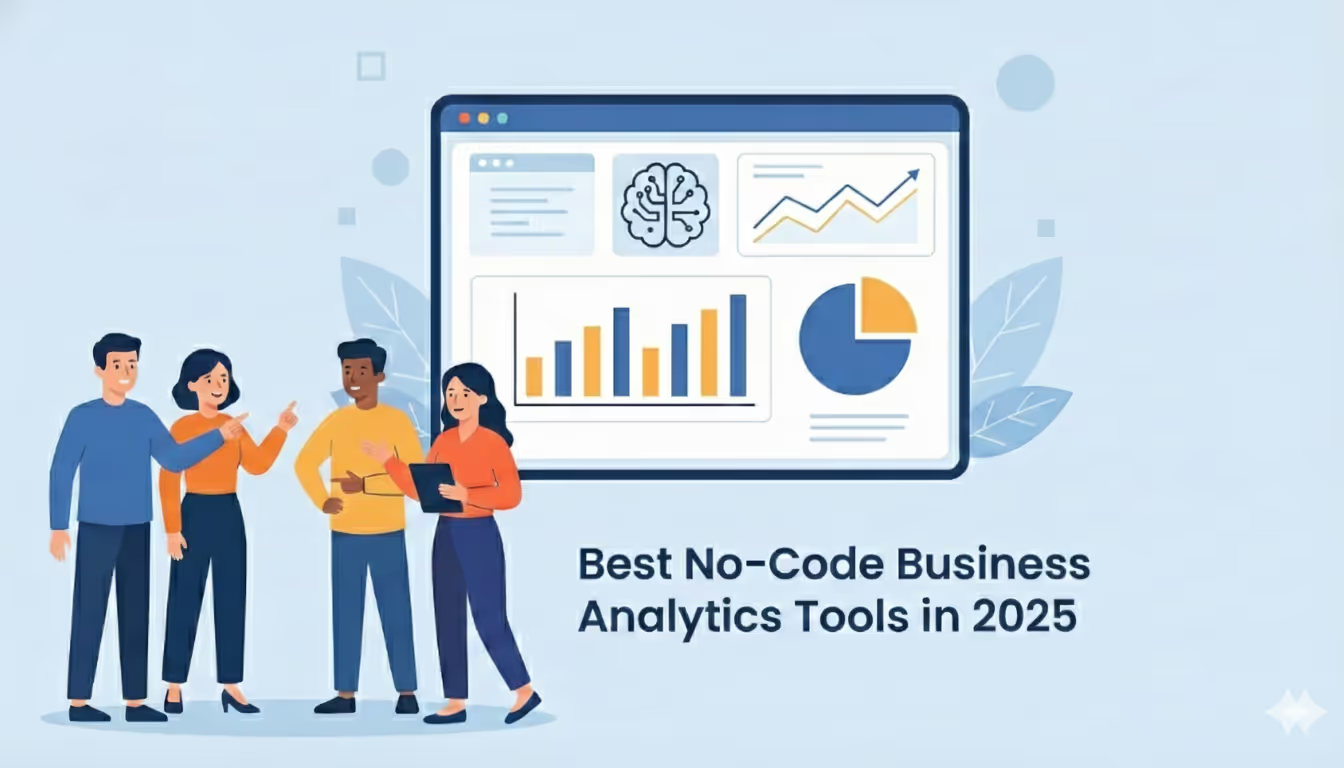
Best No-Code Business Analytics Tools in 2025 (for Non-Technical Teams)
You need data insights to make a critical decision, but getting answers means submitting a ticket to analytics and waiting days, or weeks. By the time the data arrives, the opportunity has passed.
This analytics bottleneck costs businesses more than just time. Teams make decisions based on gut feeling, opportunities slip away, and problems go undetected. Traditional BI tools promised solutions but created new barriers: dashboard overload, steep learning curves, and SQL skills most business users don't have.
In 2025, the landscape has shifted. No-code analytics platforms, powered by conversational AI, eliminate these barriers entirely. The best tools let you ask questions in plain English and get instant answers, no technical skills required.
What Are No-Code Business Analytics Tools?
No-code business analytics platforms enable anyone in your organization to analyze data without writing SQL queries or learning complex software. Instead of building dashboards or requesting reports from IT, users ask questions in natural language and receive immediate answers.
The evolution has been remarkable. Traditional BI tools like Tableau and Power BI contain limitation or rigidity for static reports. First-generation no-code solutions simplified interfaces but still required understanding data structures. Today's AI-powered conversational analytics platforms take a different approach: they use artificial intelligence to understand your question, write the necessary code, execute it on your databases, and present results in seconds.
When evaluating no-code analytics tools in 2025, look for these capabilities:
- True natural language processing that understands business terminology
- Integration with existing data sources (ERPs, CRMs, data warehouses)
- Enterprise-grade security to protect sensitive information
- Transparency so you can verify how results were calculated
The most advanced platforms now use agentic workflows, where multiple specialized AI agents work together to analyze data like a skilled human analyst would.
Top No-Code Business Analytics Tools in 2025
1. Lumi AI: Best Overall for Enterprise Teams
Agentic analytics platform represents the cutting edge of no-code analytics. Built from the ground up as a conversational AI platform, you interact with it like a skilled data analyst, asking questions in plain english and receiving comprehensive answers in seconds.
Agentic AI Architecture
What sets Lumi AI apart is its agentic workflow. When you ask a question, specialized AI agents work in sequence: one clarifies intent, another searches the knowledge base for business context, a third generates SQL or Python code, and a fourth executes and verifies results.
Extraordinary Efficiency Gains
Analyses that previously took days now complete in minutes. According to Lumi AI's case studies, this translates to upto 20x acceleration in report development, largely because it eliminates back-and-forth between business users and data teams.
Enterprise Security
Your data never leaves your network. Lumi deploys a secure gateway within your infrastructure that executes queries directly on your databases, whether SAP, Oracle, Microsoft Dynamics 365, or Snowflake. The platform is SOC 2 Type 1 compliant with role-based access controls and usage monitoring.
Transparency You Can Trust
Unlike black-box AI tools, Lumi AI shows you exactly how it arrived at any answer. You can view the actual SQL or Python code generated, understand the reasoning process, and verify the logic.
Dynamic Dashboards and Integration
The platform includes dynamic dashboards where any query result can be pinned with automatic refresh. Team members can drill down using natural language, asking follow-up questions directly from the board. Results export to Excel or CSV, or embed into Slack and Microsoft Teams.
Real-World Results
- A Fortune 50 retail enterprise troubleshot on-shelf availability issues in three minutes (previously required over a week), recapturing approximately 12% of lost sales
- A textile manufacturer reduced raw material procurement costs by 38% using Lumi's spend analysis
- Chalhoub Group identified $60M in growth opportunities by analyzing in-store purchase patterns
Ideal For
Mid-market to Fortune 500 companies in retail, consumer packaged goods, manufacturing, logistics, and e-commerce. Early adopters include Kroger, HelloFresh, GoBolt, and Chalhoub Group.
Implementation
Deployment takes approximately two weeks with less than three hours of IT effort. Schedule a demo to see how Lumi can transform your analytics in days, not months.
Other Notable No-Code Analytics Alternatives
2. Tableau Ask Data
Tableau's Ask Data feature lets users type questions to generate visualizations. While this adds conversational capability, it still requires significant upfront work to structure data properly. Users report Ask Data works well for simple queries but struggles with complex, multi-step analysis. Best suited for organizations already invested in the Tableau ecosystem with dedicated BI teams.
3. Power BI Q&A
Power BI Q&A brings natural language search to Microsoft's platform. For companies embedded in the Microsoft stack, it offers tight integration. However, Q&A requires training to understand specific business terminology, and users still need dashboard navigation skills. It's more an enhancement to traditional BI than true conversational analytics.
4. ThoughtSpot
ThoughtSpot pioneered search-driven analytics with Google-like queries. The platform handles large datasets efficiently but requires learning search syntax and understanding data models. It's faster than building dashboards manually but doesn't offer truly conversational, natural language interaction.
How to Choose the Right No-Code Analytics Tool
Selecting the right platform requires evaluating several key dimensions:
Ease of Use
Can any team member get meaningful answers immediately, regardless of technical background? Lumi AI's conversational interface requires zero training, users simply ask questions naturally.
Speed and Efficiency
According to industry research, organizations implementing advanced BI solutions see a 23% improvement in operational efficiency. Lumi AI's 30-second average response time and ability to turn week-long projects into three-minute analyses represents a quantum leap.
Enterprise Security
Does your data need to leave your network? Can the platform connect to ERPs, CRMs, and data warehouses securely? Lumi AI's architecture ensures data never leaves your environment, maintaining SOC 2 compliance throughout.
Transparency and Trust
Can you verify how results were calculated? Lumi AI addresses this by showing code and reasoning behind every answer, while its knowledge base ensures consistent business definitions across teams.
Scalability
Will the platform work across multiple departments and use cases? Agentic AI platforms like Lumi AI scale from simple queries to sophisticated root-cause analysis without requiring different tools.
Real-World Impact: Results You Can Expect
Organizations implementing modern no-code analytics platforms report transformative results:
Time Savings
Tasks that took days or weeks now complete in minutes. A data team reduced analysis time by upto 20x, enabling business users to iterate through multiple questions in single sessions.
Cost Reduction
When insights cost significantly less to generate, organizations can ask exponentially more questions. Data teams shift from bottleneck to force-multiplier, focusing on strategic modeling while AI handles routine queries.
Revenue Impact
Faster decision-making and anomaly detection drive measurable results. Retailers using Lumi AI for supply chain visibility have recaptured double-digit percentages of lost sales by identifying stockout issues in real-time instead of weeks later.
Cultural Transformation
According to TechJury research, 90% of companies report faster decision-making thanks to AI-driven BI tools. When getting data becomes as easy as asking a question, organizations develop a habit of curiosity. The self-service BI market is projected to rise to $27.32 billion by 2032, reflecting growing demand for democratized analytics.
Getting Started with No-Code Analytics
Start with a Targeted Pilot
Choose one high-value use case where faster insights make measurable difference. Supply chain teams might focus on reducing excess inventory. Sales teams could target customer churn prediction.
Fast Deployment
Modern platforms deploy remarkably fast. Lumi AI goes from kickoff to delivering insights in approximately two weeks, requiring less than three hours of IT effort. Lumi AI also offers white-glove onboarding for easy integration setup.
Measure Success
Track time saved, insights generated, and business outcomes. Monitor adoption: are users asking more questions? Are they exploring data they previously couldn't access? These behavioral changes indicate cultural shift toward data-driven decisions.
Scale Strategically
Use pilot results to build the business case for broader deployment. Common expansion paths include rolling out to additional departments, connecting more data sources, and integrating through Slack or Teams.
Conclusion
No-code business analytics has evolved from convenience to strategic imperative. Organizations can no longer afford week-long delays in traditional BI processes. According to market research, the global BI software market is expected to reach $151.26 billion by 2034, reflecting the strategic value organizations place on advanced analytics.
The landscape in 2025 offers clear differentiation. Basic no-code tools bridge the gap the technical skill gap for business users who require data accessablility. AI-enhanced BI platforms add natural language to dashboards but maintain complexity. True conversational analytics platforms like Lumi AI eliminate barriers entirely, making sophisticated analysis accessible through plain English.
For enterprises seeking to democratize data access while maintaining security and governance, agentic analytics platform Lumi AI represents the most comprehensive solution available. Its agentic AI architecture, in-network security, transparency controls, and proven results across Fortune 50 companies set a new standard.
The data bottleneck that has frustrated business teams for decades finally has a solution. The question isn't whether to adopt conversational AI analytics, but how quickly you can implement it before your competitors do.
Ready to eliminate your analytics bottleneck? See how Lumi AI can transform your team's data capabilities in just one week.
Frequently Asked Questions
What's the difference between no-code analytics and traditional BI tools?
Traditional BI requires technical skills to build dashboards and write SQL. No-code analytics eliminates these barriers. Advanced platforms like Lumi AI use conversational AI, letting you ask questions in plain English and receive instant answers with charts, no training required.
Do I still need a data team if I use no-code analytics?
Yes, but their role evolves. No-code tools automate routine queries, freeing data teams from being bottlenecks. This lets them focus on high-value work like predictive models, data governance, and strategic projects.
How secure are no-code analytics platforms?
Security varies by platform. Enterprise solutions like Lumi AI ensure data never leaves your network, deploying secure gateways within your infrastructure. Look for SOC 2 compliance, role-based access controls, and in-network processing.
How long does implementation take?
Modern AI platforms deploy much faster than traditional BI. Lumi AI implements in approximately two weeks, requiring less than three hours of IT effort. The vendor handles most integration work.
Can no-code tools handle complex analysis?
Advanced platforms with agentic AI excel at complex analysis. Lumi AI uses specialized agents that break down complicated questions, generate code, execute queries, and synthesize results, mimicking how skilled analysts work.
What ROI should I expect?
Organizations typically report 90% or greater time savings per analysis. Cost per insight can drop by more than 500x compared to manual analysis. Most enterprises see ROI within the first quarter after deployment.

Data & AI Products | Founder & CEO at Lumi AI | Ex-Director at Unicorn. Ibrahim Ashqar is the Founder and CEO of Lumi AI, a company at the forefront of revolutionizing business intelligence for organizations with a specialization in the supply chain industry. With a deep-rooted passion for democratizing data access, Lumi AI seeks to transform plain language queries into actionable business insights, eliminating the barriers posed by SQL and Python skills.
Related articles
The New Standard for Analytics is Agentic
Make Better, Faster Decisions.