AI & Analytics
The Best Agentic Analytics Platforms for Data-Driven Insights (2026 Comparison)
There is no single, universally agreed "best agentic analytics platform" ranking, and any list that hands you one is measuring feature checklists, not what a platform actually does with your data six months after you buy it. The honest answer is a scorecard you run yourself: test whether a platform repeats the same answer everywhere it's asked, whether it can show its work, and whether it knows who's asking, against your own messiest question and your own live data.
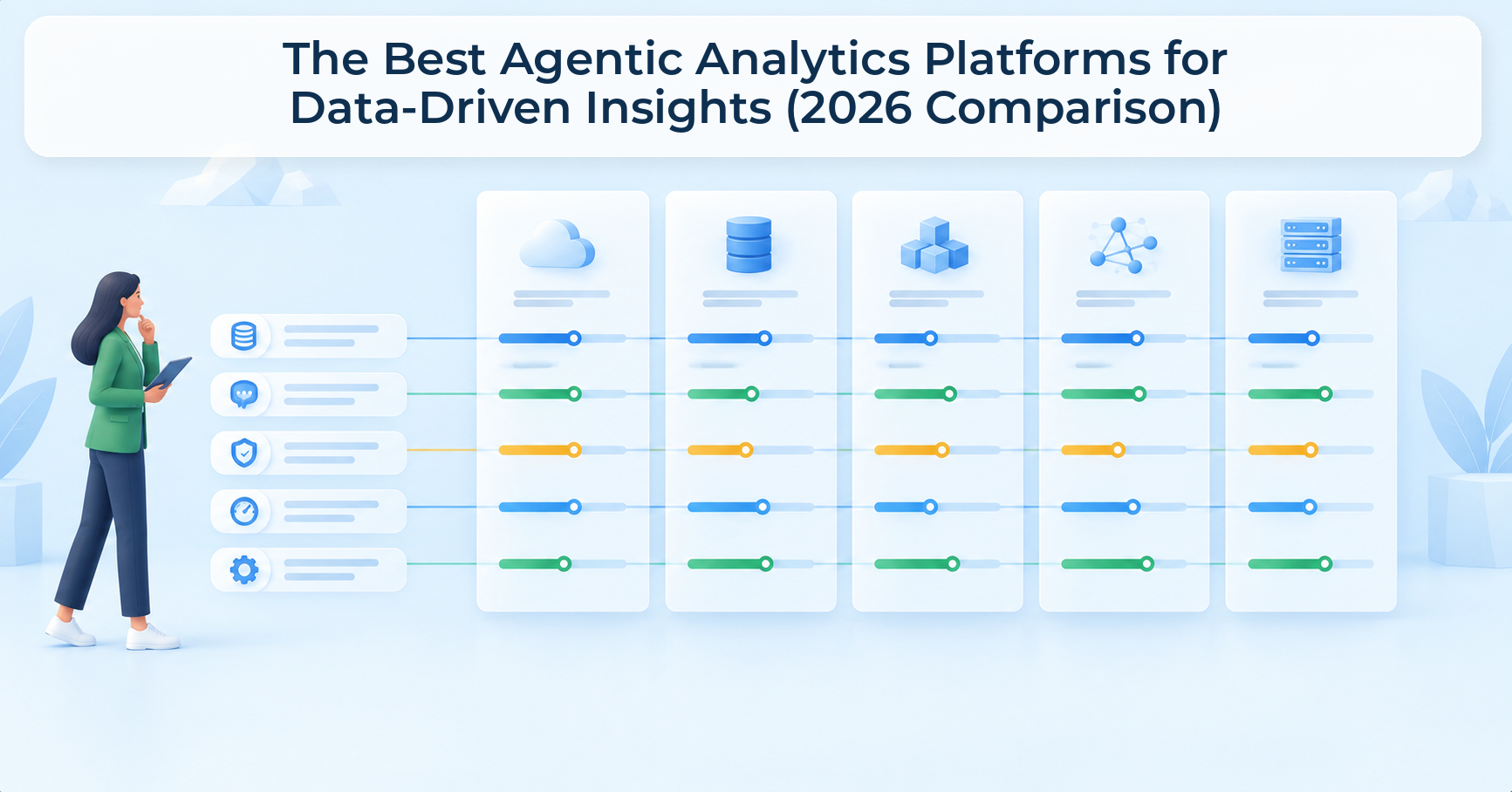
This article walks through that scorecard, shows where the three main categories of agentic analytics platforms tend to land on it, and gives you a comparison table to use as a starting point for your own shortlist.
What makes a platform "agentic" in the first place
An agentic analytics platform plans and executes a multi-step investigation against your data. It pulls context, writes and runs its own queries, checks its results, and explains how it got there, rather than answering a single prompt with a single response and stopping.
That distinction is the dividing line between an agentic workflow and conversational analytics bolted onto a traditional dashboard. A chatbot answers what you ask. An agent decides what to check next, the way an analyst would trace a number back to its source before repeating it in a meeting.
Why platform rankings don't predict what happens after you buy
A feature checklist measures presence, not performance. Two platforms can both claim a semantic layer and produce completely different answers to the same question, because having a semantic layer and maintaining one that reflects how your business actually works are not the same thing.
The gap shows up after the demo. A platform that scored well on every checkbox can still return a confidently wrong number the week your finance team redefines a metric, because the checklist never asked what happens when the business changes and nobody updates the platform's understanding of it. A vendor ships a feature update and a ranked list built on presence alone goes stale within a quarter, which is exactly why this article gives you a method instead of a leaderboard.
Common mistakes teams make during evaluation
Testing only with clean, simple questions. Bring your messiest real question, not your cleanest one. Simple lookups pass on almost any platform; the gap opens on the questions nobody thought to test during the demo.
Letting the vendor pick the test data. Ask to run the evaluation against a slice of your own live data, with your own metric definitions, not a curated sample built to look good.
Treating the sales team's answers as the product's answers. Get hands-on access before the final round of evaluation, not after the contract is signed.
Skipping the maintenance conversation. Almost no evaluation asks who keeps an answer correct in month six, which is exactly the question that determines whether the deployment survives past its first year.
The three properties that actually separate these platforms
Can it repeat the same answer everywhere it's asked?
A platform that gives one number in its chat interface and a different one through its API doesn't have a single source of truth. It has two guesses that happen to agree sometimes.
Can it show its work?
An agent that returns an answer without the query behind it is not verifiable, it's a claim you have to trust. A platform built for production shows the exact logic and source rows that produced the number, closer to human-verified oversight and a defined path to validate its insights than a black-box guess.
Does it know who's asking?
A platform that answers every question the same way regardless of who's asking will eventually show someone data they shouldn't see. Most comparison lists skip this entirely, but it belongs alongside how the platform handles security and access controls more broadly.
Where each category of platform tends to land
Instead of ranking named vendors, it's more useful to know where each broad category of agentic analytics platform tends to be strong, where it tends to struggle, and who it actually fits. Use this as a starting filter, then run the scorecard below against the specific platforms on your own shortlist.
That last row is where the operational cross-source case tends to sit. When the question that actually matters, "which stores are underperforming on the new seasonal line, and why," pulls from inventory, fulfillment, and sales data at once, a platform scoped to a single warehouse or a single dashboard tool is working against its own boundaries before it even starts reasoning. This is the specific gap Lumi AI was built for: a conversational, agentic layer over operational business data, with a self-service model that lets category managers, planners, and finance teams define their own terms without filing a ticket.
What to watch for during the demo itself
Ask to see a wrong answer, not just a right one, and watch how the platform surfaces the mistake. Watch how long it takes to get from question to traceable source data, not just to an answer, and whether that trace holds up when you ask through a query interface instead of the chat window. Ask what happens when the question is ambiguous. A platform that guesses at intent without flagging it will produce confident wrong answers exactly where a human analyst would pause.
Also ask how the platform connects to what you already run. A tool that requires a lengthy integration project before it can see real data isn't self-service yet, no matter how good the chat interface looks in the demo.
The scorecard: five tests to run
The three properties above are what you are testing for. These five tests are how you test them, against your actual shortlist rather than a spec sheet:
- Ask the same metric question through two different interfaces. Do the numbers match?
- Ask for the query or logic behind a specific answer. Can you trace it back to source rows in under a minute?
- Change a business rule and ask the same question again a week later. Did the answer update, or did it quietly stay wrong?
- Ask a question scoped to data a specific role shouldn't see. Does the platform respect that?
- Ask who owns the platform's context layer after go-live, and how much of their time that ownership costs.
If a platform can't clear all five specifically, you're evaluating a demo, not a system you can run in production.
FAQ
What makes a platform "agentic" instead of just AI-powered?
An agentic platform plans and executes multiple steps toward an answer, checking its own work along the way, rather than returning a single response to a single prompt.
Is a warehouse-native tool like Snowflake Cortex or Databricks Genie automatically the safer choice?
It inherits governance you already have, but it's usually scoped to that warehouse. If your hardest questions span multiple sources, that scope becomes a limitation rather than an advantage.
How is a scorecard different from comparing feature lists?
A feature list tells you what a platform claims to do. A scorecard tests what it actually does under conditions that resemble production, using your own data and your own edge cases. The difference shows up on the rows a checklist cannot capture: whether two interfaces return the same number, whether an answer can be traced to source rows, and whether the platform's understanding updates when a business rule changes.
Should we run this evaluation with our own data or the vendor's sample data?
Your own, whenever the process allows it. Performance on curated sample data tells you almost nothing about your actual metric definitions and edge cases.
How many platforms should we actually evaluate at once?
Fewer than most teams start with. Three serious candidates, evaluated thoroughly against the scorecard above, beats eight evaluated superficially.
Where does Lumi AI fit if my questions span more than one data source?
Lumi is built as a standalone agentic platform for operational business data specifically, ERP, inventory, sales, and fulfillment together, rather than a copilot scoped to a single warehouse. Retail and CPG teams are typically live and running real questions within about a week of connecting their data (Lumi-reported).
Where this leaves you
Before you compare another spec sheet, run the scorecard against your actual shortlist: ask the same metric question through two interfaces and check the numbers match, trace one answer back to its source rows, change a business rule and re-ask a week later, ask a question scoped to data a role shouldn't see, and ask who owns the context layer after go-live. That's a harder bar than most comparisons ask a platform to clear, and it's the only one that predicts what happens after the demo ends. Two worked examples of this kind of evaluation applied to named platforms are publicly available if you want to see the format before running it yourself, one against ThoughtSpot and one against Snowflake Copilot, and Lumi's own feature breakdown and capabilities overview are useful references while you build your test list.
If your shortlist includes questions that cross ERP, inventory, sales, and fulfillment data in one investigation, that's the specific case a standalone agentic platform built for operational data is meant to handle. Schedule a demo and bring your actual messiest question, or check pricing to see what a deployment looks like for a team your size.

Data & AI Products | Founder & CEO at Lumi AI | Ex-Director at Unicorn. Ibrahim Ashqar is the Founder and CEO of Lumi AI, a company at the forefront of revolutionizing business intelligence for organizations with a specialization in the supply chain industry. With a deep-rooted passion for democratizing data access, Lumi AI seeks to transform plain language queries into actionable business insights, eliminating the barriers posed by SQL and Python skills.
Related articles
The New Standard for Analytics is Agentic
Make Better, Faster Decisions.