The Lumi AI Glossary
Top ThoughtSpot Alternatives in 2025 (Compared for AI Analytics Buyers)
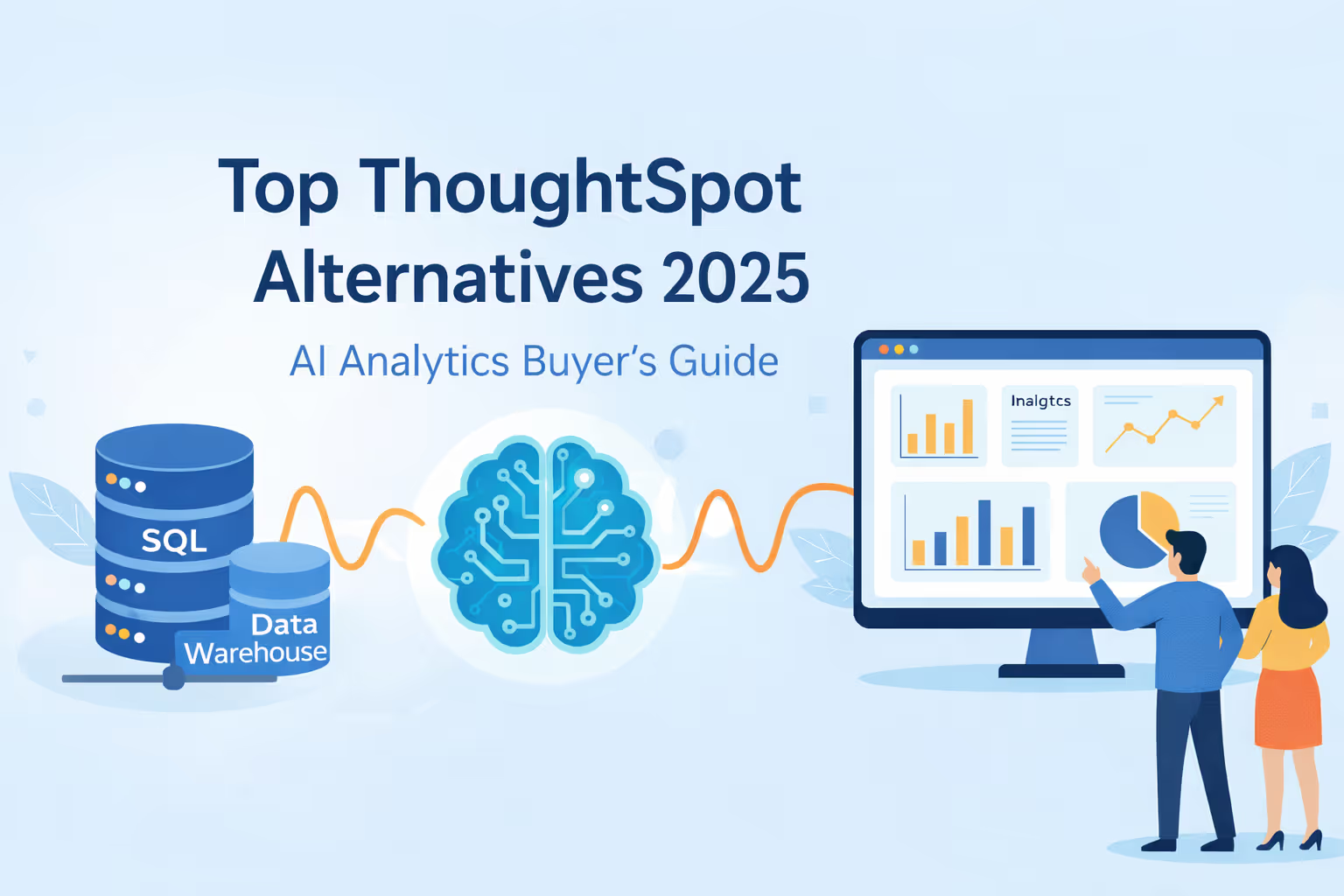
ThoughtSpot revolutionized business intelligence with search-driven analytics, but in 2025, many AI analytics buyers are exploring alternatives. The reason? ThoughtSpot's pricing can jump dramatically (from around $95/month to $1,250/month when data volume crosses certain thresholds), and its AI capabilities often still require SQL skills for complex analysis. If you're evaluating options that offer robust artificial intelligence features like natural language querying, automated insights, and machine learning with greater flexibility or affordability, this guide covers the top alternatives built for AI-driven analytics needs.
1. Lumi AI: Conversational "AI Data Analyst" Platform
Lumi AI stands out as a next-generation enterprise analytics platform designed to function as your virtual AI data analyst. Business users can ask questions in plain English and instantly receive answers as charts, explanations, or calculations, without writing a single line of code.
How Lumi AI Works
Under the hood, Lumi's AI agents translate your questions into SQL or Python code, execute it on your data, and return results with relevant visualizations. The conversational interface suggests follow-up questions to help users dig deeper. What truly sets Lumi apart is its transparency, where users can see the generated code and reasoning behind every answer, building trust in AI-generated insights.
Key Capabilities That Matter
Conversational Query & Analysis: The chat-style interface supports on-the-fly chart generation and allows drilling down by simply asking further questions. Non-technical users can iterate on analysis without technical barriers, turning what used to take days into seconds.
AI-Driven Automation: Lumi autonomously writes and executes code on your data to surface anomalies and identify key drivers. It offers AI-recommended next questions and narrative explanations, essentially automating the work that would normally require a dedicated data analyst.
Dynamic Dashboards: Any answer or chart can be pinned to a live dashboard with a single click. These boards auto-refresh and allow interactive exploration, where team members can ask new questions from any dashboard card. This combines the stability of traditional dashboards with the flexibility of ad-hoc analysis.
Semantic Layer: Lumi includes a built-in knowledge base where data definitions, business metrics, and terminology are stored for the AI. This semantic layer ensures the AI understands your business context, such as renamed fields and KPI formulas, yielding accurate, relevant answers every time.
Secure Integration: The platform connects to cloud data warehouses and databases (Snowflake, Amazon Redshift, Google BigQuery, and more) with secure connectivity. All data processing happens within your own network, never copying sensitive data to external servers.
Proven Results
Early enterprise deployments demonstrate significant impact. In a procurement scenario, Lumi identified a 38% reduction in raw material costs for a textile manufacturer by consolidating purchases with lower-cost suppliers.
Why Lumi AI Stands Out
For organizations prioritizing an AI-native BI tool that non-technical users can leverage with minimal friction, Lumi AI offers a cutting-edge conversational experience similar to ThoughtSpot's search but with superior AI automation and transparency. It democratizes data analysis while drastically reducing turnaround time for insights. The platform eliminates the "data bottleneck" by enabling instant, self-service insights for business users.
2. Microsoft Power BI: Ubiquitous BI with AI "Copilot" Features
Microsoft Power BI remains a leading analytics platform, especially for organizations in the Microsoft ecosystem. In 2025, Power BI has further infused AI into its capabilities with Microsoft's Copilot for Power BI, which uses generative AI to help build reports and insights automatically.
Power BI has long offered a natural language query feature (Q&A visual) that lets users type questions and get answers in chart form. Now, with Copilot, users can ask the system to create dashboards or uncover insights in a conversational way.
Key Strengths
Deep Microsoft Integration: Power BI integrates seamlessly with Azure data services, Excel, Microsoft Teams, and more. If your data lives on Azure SQL or you use Office 365 tools, Power BI provides native connectivity and a familiar experience.
AI and ML Capabilities: Beyond Copilot, Power BI includes features like Key Influencers (to automatically find factors impacting a metric), decomposition trees for root-cause analysis, and Azure ML integrations for predictive analytics.
Cost Consideration: Power BI is known for a low per-user price starting around $10/user/month for Pro, which is attractive for broad deployment. However, enterprise scaling or embedding reports can introduce additional costs with Power BI Premium.
Trade-offs
Power BI can produce complex analytics, but fully leveraging it often requires skilled developers or knowledge of its DAX formula language. Less tech-savvy users might struggle to build advanced reports without training.
Best for: Companies already invested in Microsoft's ecosystem or needing a broad BI platform that is incorporating generative AI assistance.
3. Tableau: Visualization Leader Embracing AI Features
Tableau, now part of Salesforce, is famous for its rich visualizations and user-friendly dashboarding. Tableau has started integrating AI capabilities to keep up with augmented analytics trends. In 2025, Tableau introduced major updates that include AI-driven insights generation.
Tableau's natural language query interface (Ask Data) allows users to ask questions of their data. Salesforce has introduced Tableau GPT and Einstein integration to automatically describe visuals and generate insights.
Highlights
Advanced Visual Analytics: Tableau provides perhaps the widest array of chart types and customization options among BI tools. It excels in creating interactive, executive-worthy dashboards with enhanced visualization controls and improved mobile experiences.
AI-Driven Insights: Tableau's latest releases incorporate AI to assist analysis, including automated insight explanations and recommendations. The platform can suggest relevant visuals or highlight anomalies using Salesforce's GPT-based models.
Considerations
While consuming dashboards in Tableau is intuitive, building those dashboards still requires skill and time. If your team lacks experienced Tableau developers, the learning curve can be steep. Embedding Tableau into custom applications isn't as seamless as modern API-first tools, and licensing costs are on the higher side.
Best for: Organizations that prioritize best-in-class visualizations and have established analytics teams.
4. Google Looker: Cloud-Native BI with Conversational Analytics
Looker (Google Cloud Looker) is a modern BI platform built around a centralized semantic layer (LookML models) ensuring a single source of truth. By 2025, Google integrated its generative AI (from the Gemini large language model) into Looker, introducing conversational analytics capabilities.
What Makes Looker a Top Alternative
Semantic Layer & Governance: All metrics and business logic are defined in LookML. This ensures every department uses consistent calculations and definitions, a big advantage for trustworthy, enterprise-wide analytics. Looker's models can span multiple databases and support row-level security.
AI-Powered Search: The addition of conversational querying (via Ask Looker using Google's LLM) brings Looker closer to ThoughtSpot's ease-of-use. Users can now get answers without writing LookML or SQL, which lowers the barrier for non-technical users.
Integration: Being a Google product, Looker integrates well with Google BigQuery and the Google Cloud ecosystem. It has an API and Embed SDK to allow embedding visualizations in other applications.
Cost and Complexity
Looker tends to be a premium solution, with many implementations running into six figures annually. It requires LookML modeling, which means you need data developers or engineers to set up and maintain the models.
Best for: If having a trusted data model and strong governance is paramount, Looker is hard to beat, especially for those already on Google Cloud.
5. Amazon QuickSight: Scalable Cloud BI with Generative Insights
Amazon QuickSight is AWS's cloud-native BI service, unique for its serverless architecture that automatically scales and usage-based pricing. The big appeal is Amazon QuickSight Q, a natural language query feature that allows users to ask questions in plain language and get answers instantly.
In 2025, AWS enhanced QuickSight Q with generative AI capabilities, providing "Generative BI" to users. QuickSight can now generate not only visuals but also contextual narratives and entire summaries of dashboards.
Why QuickSight Is Interesting
Natural Language & Generative AI: Amazon QuickSight Q acts like an AI-powered analyst. New features include executive summaries that automatically explain key insights of any dashboard in seconds, and natural language-driven visual generation where you describe what you need and QuickSight builds the chart.
AWS Ecosystem: QuickSight naturally integrates with AWS data sources (Redshift, RDS, S3) and is appealing if your infrastructure is on AWS. It's serverless and handles scaling automatically.
Cost Model: QuickSight's per-session pricing could significantly cut costs compared to ThoughtSpot's high monthly minimums, especially if you have many occasional users.
Trade-offs
QuickSight historically had fewer visualization types and customization options than Tableau or Power BI. While QuickSight Q is powerful, it benefits from proper topic modeling (configuring metadata for best results).
Best for: AWS-centric organizations seeking cost-effective cloud BI with strong natural language querying.
6. Tellius: Augmented Analytics with "Why" Insights
Tellius is a modern AI-powered analytics platform purpose-built for augmented analytics. For companies evaluating ThoughtSpot, Tellius often comes up as an alternative that promises more advanced AI features out-of-the-box.
It supports natural language queries similar to ThoughtSpot but goes further by automatically uncovering why metrics are changing using machine learning. Tellius can perform root cause analysis, key driver analysis, anomaly detection, and even build predictive models using AutoML.
Key Reasons Tellius Is a Top Alternative
Conversational BI: Like ThoughtSpot, Tellius allows you to ask questions of your data in natural language and get answers instantly. It enables unlimited drill-down where you can click on any result to further explore underlying data.
Automated Insights: A standout feature is its ability to do multi-level analysis automatically. For example, if sales dropped last quarter, Tellius can automatically analyze and produce insights on what factors contributed to that drop, essentially explaining why a metric changed.
Integrated AI/ML: Tellius includes an AI-driven data prep and modeling layer. Users can join data, create new columns, or run predictive models through a point-and-click interface.
Best for: Organizations wanting to empower users not just to find what is happening but also to quickly understand why and predict future outcomes.
Comparison Table: Key Features at a Glance
FeatureLumi AIPower BITableauLookerQuickSightTelliusNatural Language QueryAdvanced (AI agents)Basic (Q&A + Copilot)Basic (Ask Data)New (Gemini-powered)Advanced (QuickSight Q)AdvancedAI AutomationAutonomous code generationAI-assistedAI-assistedBasicAdvanced narrativesAdvanced insightsTransparencyFull code & reasoning viewLimitedLimitedLimitedLimitedPartialSetup TimeUnder 2 weeksWeeksWeeksWeeks to monthsDaysWeeksTechnical SkillsNoneDAX / Power QueryDashboard buildingLookML modelingTopic modelingMinimalCost ModelEnterprisePer user + PremiumPer user (high)Enterprise (high)Usage-basedEnterpriseBest ForAI-native self-serviceMicrosoft ecosystemVisualization expertsGoogle Cloud + governanceAWS usersAdvanced insights
Making the Right Choice for Your Organization
Empowering your organization with AI-driven analytics means finding a tool that handles your data scale and security needs while truly opening up data exploration to everyone. ThoughtSpot has led the way in search-based analytics, but several strong alternatives exist in 2025, each with a different approach to AI and self-service.
The best choice aligns with your users' skills, your data environment, and the level of AI assistance you need. If you prioritize conversational querying with full transparency into how answers are generated, Lumi AI represents the next generation of analytics. If you're deeply embedded in Microsoft, Power BI's Copilot features make sense. For visualization-first teams, Tableau delivers. Google Cloud customers benefit from Looker's governance, while AWS users find value in QuickSight's scalability. And for those wanting the deepest automated insights, Tellius excels.
Actionable Next Steps
Create a shortlist of 2-3 platforms that best match your needs based on ease of use versus advanced AI features, budget versus capabilities. Most of these vendors offer free trials or demos. Have some of your business users try asking their real questions in each tool. This will quickly reveal which AI analytics platform feels most natural and valuable for your team's daily decision-making.
Remember, the goal is to boost data-driven insights across your organization. The optimal ThoughtSpot alternative will be the one that your people actually adopt and love using, as much as it is the one with impressive technology. Start with a focused pilot, measure the impact, and scale what works.
Frequently Asked Questions
Why are companies looking for ThoughtSpot alternatives in 2025?
Companies are exploring ThoughtSpot alternatives primarily due to cost concerns and AI limitations. ThoughtSpot's pricing can escalate dramatically when data volumes cross certain thresholds, jumping from around $95 per month to $1,250 per month. Additionally, embedded usage is charged per query, which burdens growing teams. The platform's AI capabilities often handle only basic queries, with more complex analysis still requiring SQL skills or data engineers, limiting true self-service for non-technical users.
What is the best ThoughtSpot alternative for conversational analytics?
Lumi AI stands out as the premier ThoughtSpot alternative for conversational analytics. It offers a virtual AI data analyst experience where business users simply ask questions in plain English and receive instant answers with charts and explanations. What sets Lumi apart is its transparency, allowing users to see the generated code and reasoning behind every answer, building trust in AI results.
How much can organizations save by switching from ThoughtSpot?
Organizations can achieve substantial cost savings by switching from ThoughtSpot to alternatives like Lumi AI. Lumi delivers insights at 517 times lower cost compared to traditional manual analysis by eliminating the iterative back-and-forth with data teams. In one case, a food & beverage manufacturer accelerated report development by 20×, reducing time-to-insight from 7 days to 30 seconds. Additionally, by eliminating ThoughtSpot's per-query embedded charges and avoiding dramatic pricing jumps, organizations can significantly reduce their analytics spend while improving capabilities.
Which ThoughtSpot alternative requires the least technical expertise?
Lumi AI requires the least technical expertise among ThoughtSpot alternatives. The platform needs zero SQL, Python, or coding knowledge, as AI agents autonomously translate plain English questions into executable code. In contrast, Power BI requires knowledge of DAX formula language and Power Query for advanced analytics, Looker demands LookML modeling expertise, and even QuickSight benefits from topic modeling configuration. Tableau requires skilled dashboard developers for complex visualizations. Lumi's conversational interface allows non-technical users to ask questions, see how answers are derived, and trust the results without any technical barrier.
Can ThoughtSpot alternatives handle complex enterprise data environments?
Yes, leading ThoughtSpot alternatives are built for complex enterprise data environments with robust security and scalability. Lumi AI, for example, is SOC 2 compliant and processes all data within your own network, never copying sensitive data to external servers. It connects securely to cloud data warehouses (Snowflake, Redshift, BigQuery) and on-premises databases, with fine-grained permission controls for role-based access. These platforms are designed for mid-market to Fortune 500 companies dealing with multiple data systems, high data volumes, and strict security requirements.

Data & AI Products | Founder & CEO at Lumi AI | Ex-Director at Unicorn. Ibrahim Ashqar is the Founder and CEO of Lumi AI, a company at the forefront of revolutionizing business intelligence for organizations with a specialization in the supply chain industry. With a deep-rooted passion for democratizing data access, Lumi AI seeks to transform plain language queries into actionable business insights, eliminating the barriers posed by SQL and Python skills.
Related articles
The New Standard for Analytics is Agentic
Make Better, Faster Decisions.