Business Intelligence
Top Omni BI Alternatives in 2025: Which Analytics Platform Is Right for You?
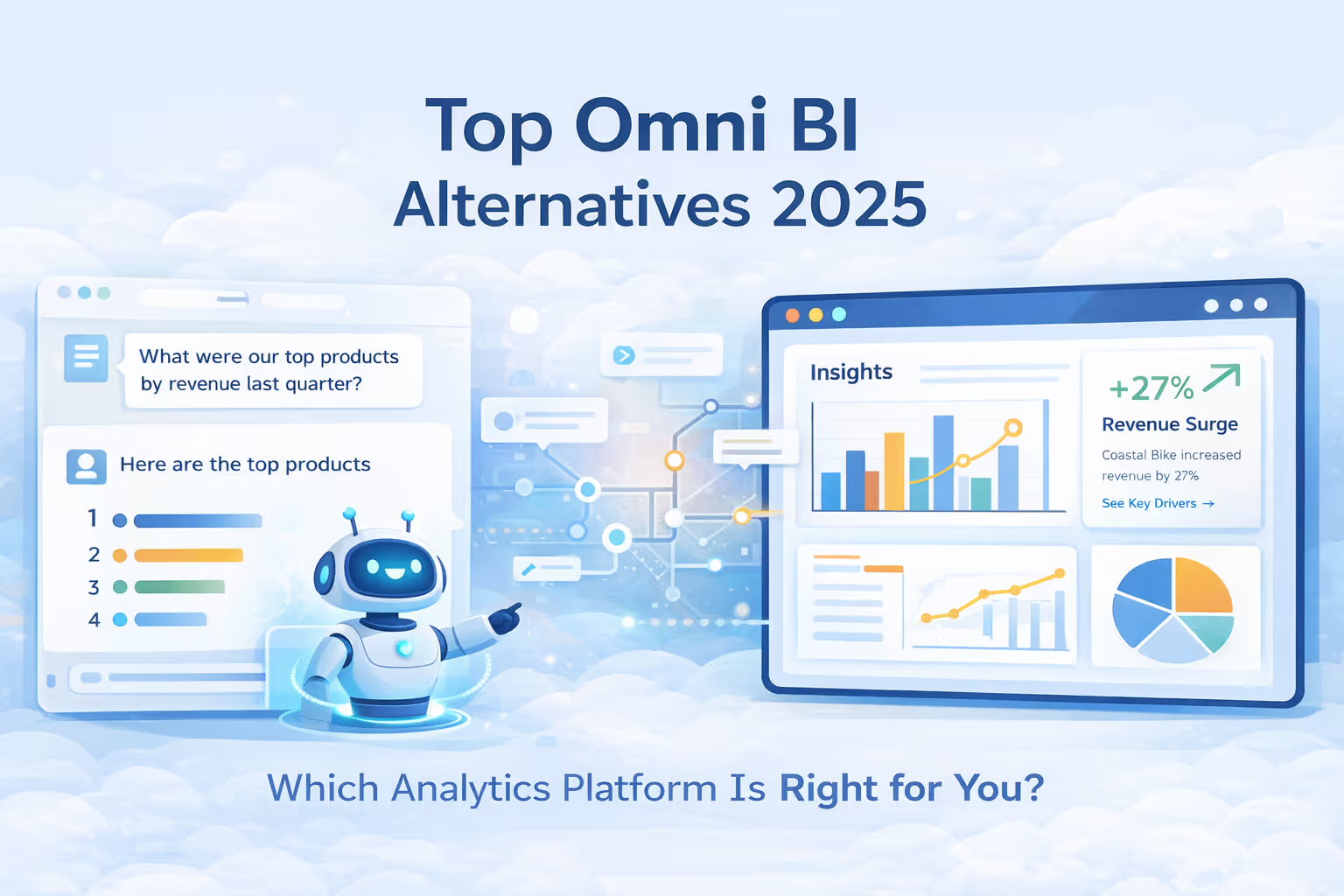
Business intelligence has undergone a dramatic transformation. Static dashboards and pre-built reports are giving way to AI-powered conversational analytics that function like intelligent assistants. Platforms like Omni BI have pioneered this shift, using large language models and semantic layers to let users ask questions in plain English and receive trustworthy insights instantly.
This guide examines the top Omni BI alternatives in 2025, evaluating them on conversational capabilities, data governance, ease of use, integration options, scalability, and cost efficiency.
What Makes a Modern BI Platform? Key Evaluation Criteria
Modern analytics platforms are evaluated on seven critical dimensions that distinguish them from traditional tools.
Conversational Analytics enables users to ask questions in natural language and receive immediate answers with visualizations. Rather than writing SQL queries, users simply type "What were our top 5 products by revenue last quarter?" and get instant results.
Semantic Layer and Governance ensures everyone works from a single source of truth. A robust semantic data model defines metrics, business terms, and relationships consistently, so when users ask about "revenue," the platform knows exactly what that means in your business context.
AI-Driven Insights and Automation goes beyond answering questions to proactively surfacing anomalies, trend analysis, and AI-generated explanations. Modern platforms explain why metrics changed and suggest what to investigate next.
Self-Service and Ease of Use determines whether business users can explore data independently without technical teams. The best platforms offer intuitive interfaces or AI-assisted analysis requiring no coding skills.
Integration and Collaboration encompasses connections to existing data stacks, real-time data support.
Scalability and Performance ensures platforms handle large, complex datasets through cloud-native architecture and optimized processing, while supporting on-premise deployments when needed.
Cost Efficiency extends beyond license fees to implementation time, maintenance requirements, and productivity gains from faster insights.
Top Omni BI Alternatives: Comprehensive Comparison
1. Lumi AI: Best Overall Alternative to Omni BI
Lumi AI stands as the premier alternative to Omni BI, delivering enterprise-grade conversational analytics with a semantic knowledge base ensuring accurate, consistent insights. The platform acts as a virtual data analyst, allowing users to ask questions in plain English and receive analytical results with charts and explanations in seconds.
Why Lumi AI Leads the Market
Lumi's unique agentic AI workflow sets it apart. When you ask a question, specialized AI agents collaborate to clarify your query, retrieve context, generate SQL or Python code, execute it, and verify results. This multi-agent approach mimics expert analyst workflows but completes in moments.
The platform delivers unprecedented transparency. Users can view the actual code generated for each answer, building trust and enabling verification of logic, critical for enterprise AI adoption.
Core Capabilities That Drive Results
The conversational chat interface eliminates dashboard overload. Users ask questions and receive instant answers with visualizations, AI-recommended follow-up questions, and feedback mechanisms to tune performance.
The semantic knowledge base forms the intelligent core. Data teams define business metrics, KPIs, and terminology specific to your organization. You can add context to Lumi AI that "In Stock %" follows a certain formula or industry aliases, ensuring the AI speaks your company's language and calculates correctly.
Proven Enterprise Impact
A Fortune 5 retailer reduced analysis time from over a week to under three minutes using Lumi, enabling planners to ask questions in plain language and get instant, code-backed answers. This dramatic acceleration means insights that were previously too expensive or time-consuming to pursue become routine.
For operations, Lumi excels at identifying exceptions like stores not following inventory protocols. One retail deployment identified stockout issues driving sales losses, leading to 12% revenue recovery. In procurement, Lumi identified a 38% reduction in raw material procurement costs through vendor consolidation.
Enterprise-Grade Security and Integration
Lumi processes all data within your network. The secure gateway or direct connector ensures sensitive information never leaves your infrastructure, meeting SOC 2 compliance with on-premise options available.
Rapid Deployment
Organizations deploy Lumi in approximately two weeks, requiring less than three hours of IT effort. Structured pilot programs begin with high-value use cases like supply chain planning, demonstrate value quickly, then expand enterprise-wide.
Explore Lumi AI pricing and start your pilot →
2. ThoughtSpot: Search-Driven Analytics at Scale
ThoughtSpot is one of the oldest conversational analytics platforms, but requires upfront modeling of database connections and governed setup. The Spotter AI agent brings conversational analytics with contextual awareness and follow-up suggestions. Ask "Why did sales dip in Region A?" and Spotter answers with charts while suggesting which product categories to explore next.
ThoughtSpot empowers business users to interrogate massive cloud datasets easily. However, it requires well-modeled data layers upfront, with data engineers setting up governed Worksheets. Consumption-based pricing starts around $1,250 monthly for 20 users, positioning it at the higher market end.
For large enterprises with complex cloud data needs and appropriate budgets, ThoughtSpot delivers powerful search-driven analytics with emerging AI capabilities.
3. Microsoft Power BI: Ecosystem Integration with Copilot
Power BI remains widely deployed, known for user-friendly dashboarding and Microsoft stack integration. Power BI Copilot brings generative AI, letting users describe desired reports in natural language while the system generates interactive pages automatically.
Copilot excels at Q&A on existing reports, summarizing visuals and scanning multiple pages to answer questions. This transforms Power BI from passive display to interactive analytical assistant.
At $10 per user monthly for Pro licenses, it significantly undercuts competitors. However, full AI capabilities require Power BI Premium at approximately $4,995 monthly capacity-based pricing.
Power BI ideal for Microsoft-embedded organizations with data in SQL Server or Azure and heavy Office 365 usage. Familiarity reduces training needs, and enabling Copilot offers incremental AI adoption without platform replacement.
4. Tableau: Visual Analytics with Emerging AI
Tableau is synonymous with visualization excellence. Under Salesforce, it's evolving with Tableau GPT and Tableau Pulse as part of Einstein GPT initiatives.
Tableau GPT provides natural language interfaces for exploration, interpreting queries to return explanations with visualizations. Tableau Pulse delivers proactive, personalized insights without users asking, with AI highlighting notable metric changes like "Customer Satisfaction dropped 5 points this week, likely due to longer support ticket times."
Visualization capabilities and Salesforce integration remain strengths. However, generative AI features are maturing as of 2025, with some functionality in pilot. Creator tier licensing runs around $70 per user monthly.
For organizations with existing Tableau investments valuing polished visuals and Salesforce integration, GPT and Pulse add AI augmentation. It's particularly suited for executive dashboards where AI-generated narratives surface important changes automatically.
5. Google Looker: Governed Metrics with Duet AI
Looker is renowned for semantic modeling through LookML and Google Cloud integration. Its philosophy centers on defining metrics once centrally and reusing everywhere for consistent results.
Duet AI (now Gemini AI) adds conversational analytics. Users interact with chat assistants in Looker, asking for explanations, comparative visualizations, or new metrics via natural language prompts.
A unique advantage is multi-modal output. Duet AI generates presentations or summaries based on insights, exporting slides in Google Slides with charts and narratives.
The semantic layer becomes more powerful with AI. Assistants use LookML definitions ensuring correct, consistent answers while providing natural language convenience.
However, building LookML models requires coding-like work, creating steeper learning curves. Pricing tends toward premium enterprise levels, often six or seven figures annually.
For organizations emphasizing governance with complex metrics, particularly using Google Cloud and BigQuery extensively, Looker with Duet AI combines consistency with cutting-edge AI assistance.
6. Qlik Sense: Associative Engine Meets Agentic AI
Qlik Sense distinguishes itself through associative analytics engines, allowing free data exploration by making selections and seeing associations across entire datasets rather than rigid drill paths.
Insight Advisor features have infused AI for years. As of 2025, Qlik advances toward "Agentic AI" with enhanced Insight Advisor Chat powered by generative AI, enabling natural language dialogs tapping structured and unstructured data.
Qlik AutoML integrates with Sense, letting users ask "What factors influence customer churn?" and receive conversational explanations with ML-driven predictor rankings.
The agentic AI vision involves autonomous agents continuously monitoring data for opportunities or issues, proactively alerting users with insights and potentially triggering automated actions.
Qlik's flexibility in exploration is powerful for discovering unexpected insights. The platform has robust security, scalable architecture, and proven large deployment track records.
However, the associative paradigm requires education, and UI is sometimes perceived as less intuitive than competitors. Pricing tends toward $30 to $70 per user monthly plus add-ons.
For large enterprises with complex scenarios, fragmented data, and governed discovery needs, Qlik offers mature capabilities now enhanced with conversational AI guiding exploratory analysis.
How to Choose the Right Omni BI Alternative
Selecting optimal platforms depends on organizational context, priorities, and constraints.
For AI-first experiences with minimal setup, Lumi AI leads. Its conversational interface eliminates dashboard overload, requires no coding, and deploys in one week with minimal IT effort. Transparent AI showing code behind answers builds adoption-driving trust.
For governance, scale, and reliability, consider Lumi AI for semantic knowledge bases, ThoughtSpot for cloud warehouse interrogation, or Looker for LookML modeling. All ensure consistent answers with centrally defined logic.
For ecosystem alignment, leverage existing investments. Power BI excels in Microsoft environments, Tableau with Salesforce, and Looker with Google Cloud. Synergies reduce integration complexity and often improve total cost of ownership.
For transparency and trust, Lumi AI's code transparency stands alone. Every answer includes options to view generated SQL or Python, reasoning processes, and consulted data sources. This explainability matters for regulated industries or risk-averse organizations.
For immediate ROI, Lumi AI's two weeks deployment, proven time acceleration, and documented 12% revenue recovery and 38% cost reduction opportunities provide fastest paths to measurable impact.
Why Lumi AI Stands Out as the Best Alternative
While several strong Omni BI alternatives exist, Lumi AI distinguishes itself through unique capabilities designed for enterprise operational analytics.
The platform delivers fastest time-to-value in the category. One-week deployments with under three hours IT effort, white-glove onboarding handling integration, and immediate post-training insight generation with 90% time savings.
True democratization separates Lumi from competitors. Conversational interfaces require no SQL, Python, or technical skills. Business users in supply chain, operations, procurement, and sales ask complex questions and receive sophisticated, code-backed insights through natural language dialogue.
Transparent, trustworthy AI addresses critical enterprise concerns. Unlike black boxes, Lumi shows code and logic behind every answer, enabling verification, building confidence, and facilitating learning.
Purpose-built for operations with specialized templates for supply chain visibility, demand planning, inventory optimization, procurement analytics, warehouse operations, and sales performance. This operational focus resonates with retail, CPG, manufacturing, and logistics companies.
Proven enterprise impact is documented. Organizations report revenue recovery from identifying stockouts, procurement cost reduction from vendor consolidation, and dramatic analytical workflow acceleration. These are measured production outcomes, not theoretical benefits.
The agentic multi-agent architecture represents sophisticated AI analytics. Specialized agents collaborate to clarify, retrieve context, generate code, execute analyses, and verify results, mimicking expert analysts for reliable, nuanced insights.
For organizations evaluating Omni BI alternatives, Lumi AI offers the most comprehensive solution combining conversational ease-of-use with semantic governance, transparent AI with enterprise security, and rapid deployment with proven ROI.
Conclusion
Business intelligence has fundamentally transformed. Modern platforms prioritize conversational interaction, semantic governance, and proactive AI over static dashboards. While Omni BI pioneered semantic layers with large language models, several strong alternatives now compete.
The optimal choice depends on priorities. Microsoft, Salesforce, or Google ecosystem embeds may find natural extensions in Power BI, Tableau, or Looker. Enterprises requiring flexibility might prefer Qlik Sense. Companies with massive cloud warehouses could benefit from ThoughtSpot.
However, for organizations prioritizing speed-to-insight, user accessibility, transparent AI, and proven operational impact, Lumi AI delivers the most compelling alternative to Omni BI. The combination of zero-technical-skill conversational analytics, semantic knowledge bases ensuring consistent metrics, transparent AI showing code, and one-week white-glove deployment positions Lumi as the premier choice for mid-market to enterprise operational industries.
Consider immediate needs, technical landscapes, and strategic goals. Run pilots with top contenders using actual data and real business questions. The platform delivering accurate answers fastest, driving adoption most effectively, and demonstrating measurable impact is the right choice.
Start your Lumi AI pilot today and discover how enterprises reduce analytics costs by 517× while accelerating insights.
Frequently Asked Questions
What is the best alternative to Omni BI?
Lumi AI is the best overall alternative, offering similar conversational analytics with semantic knowledge bases but with faster one-week deployment, transparent AI showing code behind answers. Purpose-built for enterprise supply chain, retail, and operations with white-glove onboarding requiring under three hours IT effort, organizations report dramatic analytical acceleration, revenue recovery from operational insights, and significant identified cost reduction opportunities.
How do Lumi AI and Omni BI compare?
Both use semantic layers and large language models for natural language analytics ensuring consistent, trustworthy answers. Lumi AI differentiates through agentic multi-agent workflows mimicking expert reasoning, complete code transparency allowing SQL or Python verification, specialized supply chain and operations templates, and speed focus with seven-day analyses completed in three minutes. Lumi emphasizes 517-times cost efficiency compared to manual analysis with white-glove onboarding minimizing IT deployment burdens.
Which BI platform is best for non-technical users?
Lumi AI, Zenlytic, and ThoughtSpot offer accessible conversational interfaces requiring no coding. Lumi AI leads with natural language chat needing zero SQL or Python, transparent AI building trust through reasoning and code visibility, and second-response capabilities for complex questions. Semantic knowledge bases understand company-specific terminology and metrics, so users ask questions in familiar business language rather than technical database terms, driving adoption among operations managers, planners, and analysts.
What's the difference between traditional BI and conversational analytics?
Traditional BI relies on pre-built dashboards requiring menu navigation or analyst-created views. Users need technical skills or data team support for ad-hoc questions. Conversational analytics platforms like Lumi AI, Omni, and ThoughtSpot let users ask plain English questions receiving instant visualized answers. This eliminates dashboard overload, democratizes access beyond technical specialists, reduces scarce data team dependencies, and accelerates decision-making by turning week-long projects into minute-long conversations. Organizations report dramatic data-driven discussion increases when users self-serve through conversational interfaces.
How much do Omni BI alternatives cost?
Pricing varies significantly. Power BI starts at $10 per user monthly for Pro, though AI requires Premium at approximately $4,995 monthly. Lumi AI ranges from $50 to $75 per user monthly with enterprise custom pricing. ThoughtSpot uses consumption-based pricing starting around $1,250 monthly for 20 users. Tableau Creator runs approximately $70 per user monthly, while Looker and Qlik involve enterprise contracts with role and volume-based pricing. Evaluate total ownership costs including implementation time, analyst productivity gains, and business impact from faster insights.
Can these platforms integrate with existing data warehouses?
Yes, all leading alternatives connect to major cloud warehouses including Snowflake, BigQuery, Redshift, and Databricks, plus on-premise databases. Lumi AI additionally integrates with ERP systems like SAP, Oracle, and Microsoft Dynamics for supply chain cases with secure in-network processing keeping sensitive data within infrastructure. ThoughtSpot queries data in place without ETL. Power BI, Tableau, and Looker offer extensive connector libraries. Qlik provides cloud connections and strong integration for hybrid environments. Most support cloud and on-premise deployment meeting various security and compliance requirements.

Data & AI Products | Founder & CEO at Lumi AI | Ex-Director at Unicorn. Ibrahim Ashqar is the Founder and CEO of Lumi AI, a company at the forefront of revolutionizing business intelligence for organizations with a specialization in the supply chain industry. With a deep-rooted passion for democratizing data access, Lumi AI seeks to transform plain language queries into actionable business insights, eliminating the barriers posed by SQL and Python skills.
Related articles
The New Standard for Analytics is Agentic
Make Better, Faster Decisions.