The Lumi AI Glossary
The Best Way to Prevent AI From Answering Questions It Doesn't Have Data For
Someone on your team asked your AI analytics tool about average contract value for churned enterprise customers last quarter. The tool answered immediately, a clean number, a confident tone, no caveats. You spent the next two days trying to trace it back to an actual dataset. You couldn't. The data it described either didn't exist in your environment or had never been connected to the system.
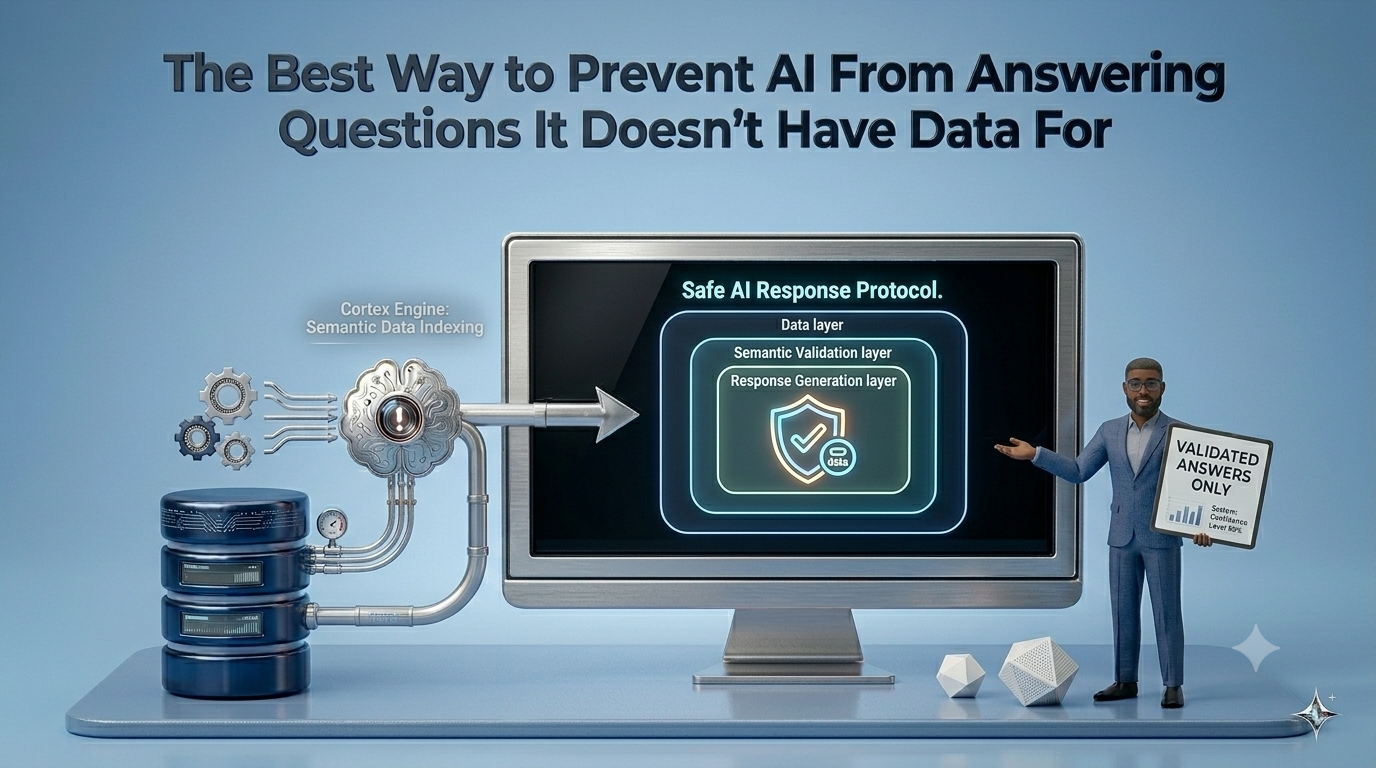
That failure has a name. It isn't hallucination in the classic sense. It's scope failure, and it's the more common, more damaging problem in enterprise analytics AI. The fix isn't a better prompt or a smarter model. It's a different architecture: one that defines what the AI is permitted to know before any question gets answered, intercepts ambiguous inputs before generation runs, and routes ungrounded responses back before they reach users. This article walks through exactly how that works.
When AI Doesn't Know What It Doesn't Know
The standard explanation for AI hallucination, that language models predict statistically likely tokens rather than retrieving verified facts, is technically accurate but misses the more practical problem in analytics contexts.
Your AI isn't always making up facts. Sometimes it's answering questions that fall entirely outside its actual data coverage, using whatever signals it can find to produce something plausible. The result looks like an answer. It has the shape of a real business metric. It gets cited.
What is AI scope failure in analytics?AI scope failure occurs when a system generates a confident-sounding response to a question that falls outside its actual data coverage, not because the model is broken, but because no mechanism exists to tell it where its knowledge ends. In enterprise analytics, this is more common and more damaging than standard hallucination, because the output looks authoritative even when no corresponding data exists.
Research published at NAACL 2024 found that AI systems without proper context grounding achieve 10–31% accuracy on domain-specific tasks. Systems with structured, context-aware grounding reach 94–99%. The gap isn't model quality, it's whether the system knows what it's permitted to reason over. Even purpose-built domain tools produce inaccurate outputs in 17–34% of cases when scope boundaries aren't actively governed.
The problem compounds quickly. A number gets shared in a Slack thread. It lands in a deck. A decision gets made. By the time someone traces it back to the AI, the question of where the data came from feels beside the point. That erosion of trust in AI-generated analytics is how organizations end up reverting to manual reporting six months into a deployment.
The good news: this is an architecture problem, which means it has an architecture solution.
Why Most Fixes Don't Work
The most common advice for preventing AI from making up answers falls into three buckets: improve your prompts, add retrieval-augmented generation (RAG), or implement human review. Each one helps at the margins. None of them closes the gap.
Better prompts give the model clearer instructions, but they can't anticipate every out-of-scope question a business user will ask. You cannot write a system prompt that covers every metric your AI doesn't track. When a user asks something the prompt doesn't address, the model still tries to answer.
RAG improves grounding by retrieving relevant documents or data before generating a response. But RAG is a retrieval mechanism, not a scope enforcer. If a user asks about a metric that doesn't exist in your connected data, RAG returns noise or silence, and the generation model may still produce a plausible answer from patterns in its training data rather than admitting it has nothing to retrieve. RAG tells the model what's available; it doesn't stop the model from ignoring that signal.
Human-in-the-loop review catches errors after the fact. At scale, it can't keep up. More critically, it catches errors after a user has already seen and potentially acted on the output. For a real-time analytics query, "we reviewed it afterward" isn't a control, it's a cleanup process.
The structural gap all three approaches share: they operate on the output side. None of them define, at the system level, what the AI is and isn't permitted to know about your business. That's the definition layer, and it has to come first.
The Three-Layer Architecture That Actually Works
Preventing AI scope failure in enterprise analytics requires three interlocking components. Each one handles a distinct failure point. Taken together, they create a system that can say "I don't have that" as reliably as it can produce accurate answers.
Layer 1: The Semantic Layer as Scope Contract
A semantic layer isn't metadata. It's a governed, business-defined structure that encodes exactly what your AI is permitted to reason over, which metrics exist, what they mean in your specific business context, how entities relate, and which data sources are authoritative.
Consider what happens without one. Your AI receives a query against a raw database schema and has to infer what "revenue" means, whether "enterprise customer" has a threshold, and which table holds the churn flag. It will make those inferences. Sometimes it gets them right. Sometimes it silently applies a definition from a different industry, a different company, or a statistical pattern from its training data.
A tightly-defined semantic layer removes that inference step. If "enterprise customer" means accounts with ARR above $50,000 in your business, that definition lives in the semantic layer and the AI consults it before generating anything. If a metric isn't defined there, the AI has no path to surface it, there is no silent fallback.
Snowflake's Cortex Analyst implementation demonstrates this concretely: providing the model with a rich semantic specification in YAML, paired with Semantic Views that define entities, join paths, and metric relationships, measurably improves SQL accuracy and reduces hallucinations. The mechanism isn't a better model, it's a more precisely defined scope contract.
The semantic layer doesn't just improve accuracy. It creates auditability. When an answer comes back, you can trace exactly which business definitions and data relationships it drew from, because those are the only ones the system was permitted to use. Lumi AI's Knowledge Management layer works this way — storing field definitions, table relationships, business rules, KPIs, and aliases so that every insight reflects the true meaning of your data.
Layer 2: Multi-Agent Workflows That Clarify Before They Answer
Vague questions are the most common trigger for scope failure. "What was our growth last quarter?" could mean revenue growth, user growth, transaction volume, MQL growth, or a dozen other metrics depending on who's asking and why. A single-pass AI system takes that question, picks an interpretation, and generates an answer. It doesn't ask which one you meant.
A multi-agent workflow adds a disambiguation step before generation runs. An orchestrating agent receives the user's question and checks it against the semantic layer. If the question maps cleanly to available data with a clear definition, it proceeds. If the question is ambiguous, or references a concept that isn't in the semantic layer, the orchestrating agent surfaces a clarifying question or flags the query as outside available data coverage, before any answer is generated.
Amazon's research on multi-agent evaluation systems formalizes this as "topic adherence refusal", the ability of an agent to decline answering questions outside its defined domain and, where appropriate, route them back for clarification rather than attempting a response. Their published evaluation framework treats this as a distinct agent capability that must be explicitly measured, not assumed.
This matters most for the questions your users actually ask. No one in a business context asks perfectly precise analytical queries. They ask in natural language, with organizational shorthand, with implicit assumptions about what data you have. A system built to handle that reality has to intercept ambiguity upstream. Disambiguation after generation is too late.
Layer 3: Evaluator Agents That Reject Ungrounded Responses
Even with a governed semantic layer and a disambiguation step, some responses will reach the generation stage that shouldn't be surfaced to users. The third layer handles this: an evaluator agent that reviews the primary agent's output against the available data before it reaches anyone.
The evaluator agent isn't fact-checking against the internet. It's checking whether the response is constructed from data the system actually has access to. If the response references a metric not present in the semantic layer, or draws a conclusion that can't be traced back to available data, the evaluator flags it and routes it back for reformulation, not to the user as an error message, but back into the pipeline for another pass.
This is what "sense-checking" means in practice. The response loop is closed internally. The user sees either a grounded answer or a clear statement that the system doesn't have sufficient data to answer the question, not a confident fabrication.
AWS research on multi-agent validation shows that adding cross-validation between agents before surfacing outputs catches a large class of hallucinations that single-pass systems miss entirely. Semantic tool selection alone reduces agent errors by up to 86.4%. The evaluator layer isn't redundant with the semantic layer; it catches the cases where the semantic layer's scope boundaries weren't sufficient to prevent a generation attempt.
The architectural point that distinguishes this from monitoring: the evaluator runs inside the pipeline, not on top of it. By the time a monitoring tool sees an output, the user has already seen it too. The evaluator gate operates before that moment.
What "Knowing What It Doesn't Know" Looks Like in Practice
Take a real query: "What's our average contract value for enterprise customers who churned last quarter?"
Scenario A: The architecture works. The system has CRM data, billing records, and churn flags mapped in the semantic layer. "Enterprise customer" is defined as accounts with ARR above $50,000. The disambiguation agent checks the query, confirms all three data elements are available, and clarifies whether "last quarter" means the fiscal or calendar quarter. The generation model runs against grounded data. The evaluator agent confirms the output references only mapped metrics. The user gets an answer they can trace.
Scenario B: The data isn't there. The churn flag lives in a CRM dataset that hasn't been connected to the analytics environment. The disambiguation agent checks the query against the semantic layer, identifies that churn data has no mapped definition, and returns: "I don't have access to churn data in this environment. You may want to connect your CRM dataset, or I can answer this question using the retention metrics I do have access to." The user learns something useful, that a data connection is missing, instead of receiving a fabricated number.
Scenario C: No architecture. A single-pass AI system receives the same query. It has billing data but no churn flag. It generates an average contract value by reasoning over billing records, applies a plausible inference about which accounts might be considered churned based on payment status, and returns a confident number. The number isn't traceable. It may be close to accurate. It may not be. No one knows, including the system.
Scenario C is what most enterprise analytics AI deployments actually look like today. That's why 78% of enterprises are running AI pilots but only a fraction are successfully deploying agents in production: the gap between a demo that works and a system that can be trusted at scale is precisely this architecture.
Frequently Asked Questions
What's the difference between AI hallucination and an out-of-scope AI answer?
Hallucination means the AI generated something factually incorrect, it said something false about something it did have data on. An out-of-scope answer means the AI responded to a question that falls entirely outside its data coverage, it didn't get the facts wrong so much as it invented facts that correspond to no real data in the system. In enterprise analytics, out-of-scope answers are the more frequent failure mode. They look authoritative, arrive with the same confidence as accurate outputs, and are harder to catch because there's no correct answer to compare them against.
What is an evaluator agent and how does it prevent bad answers from reaching users?
An evaluator agent is a secondary AI agent in a multi-agent pipeline whose job is to review the primary agent's generated response before it surfaces to the user. It checks whether the response is grounded in data the system actually has access to, not whether it sounds plausible or grammatically correct. If the response references concepts or figures that aren't in the system's data model, the evaluator routes it back for reformulation. The user never sees the ungrounded draft. What they see is either a verified answer or a clear statement that the system lacks sufficient data to respond.
Does a semantic layer actually stop AI from going out of scope?
Yes, but only if it's tightly defined and actively maintained. A semantic layer that encodes your actual business data model, metric definitions, entity relationships, authoritative data sources, acts as a scope contract. The AI can only reason over what's defined there. If a concept isn't in the semantic layer, the AI has no legitimate path to surface it. This is the key distinction from RAG: RAG retrieves broadly from available documents and lets the model decide what's relevant; the semantic layer specifies in advance exactly what the AI is and isn't permitted to know about your business.
Can prompt engineering solve this problem instead?
Prompt engineering can reduce the frequency of scope failures for known, predictable queries. It cannot handle the long tail of questions real business users ask in natural language. You cannot write a system prompt that anticipates every metric your AI doesn't track or every ambiguous phrasing your team will use. Prompt-level guardrails are useful as a layer on top of a governed architecture; they are not a substitute for one.
How does disambiguation before generation differ from asking users to be more specific?
Asking users to write better questions pushes the problem onto the people least equipped to solve it, non-technical business users who shouldn't need to know what data is available before asking a question. Disambiguation in a multi-agent workflow shifts that responsibility to the system. The orchestrating agent checks the question against available data, identifies where the query is under-specified or out-of-scope, and surfaces a targeted clarifying question, or routes the query back with an explanation of what data would be needed. The user gets a helpful response either way.
Choosing an AI Analytics Tool That Gets This Right
Most analytics AI vendors will tell you they have guardrails against hallucination. The question worth asking is where those guardrails operate and what they actually check.
Ask whether the system has a governed semantic layer, or whether the AI reasons over raw database schemas and makes its own inferences about what business terms mean. A vendor who can't distinguish between the two hasn't solved the scope problem.
Ask what happens when a user's question doesn't map to available data. Does the system return a clear "I don't have that" message, a clarifying question, or a confident answer that may or may not be grounded? The answer tells you whether there's a disambiguation layer or whether the system runs single-pass.
Ask whether there's an automated sense-check step before answers reach users, and what triggers it. Human review isn't an architecture. An evaluator agent that runs inside the pipeline is.
Ask whether you can see what data the AI used to construct any given answer. Auditability isn't a nice-to-have in enterprise analytics, it's the only way to build and maintain trust in AI-generated outputs over time.
A vendor who answers all four questions with specificity is building production-grade systems. A vendor who responds with general claims about model quality or prompt engineering is describing a demo.
See It in Your Data Environment
Understanding the architecture is step one. Seeing how it maps to your actual data model, your existing metric definitions, and the questions your team asks every day is where it gets concrete.
Lumi AI's semantic layer and Knowledge Management, multi-agent agentic workflows, and evaluator pipeline are built for exactly the production deployment gap described here. Lumi's conversational analytics engine lets every business user explore data in plain language, while the self-service analytics layer ensures every answer is grounded in your actual business definitions. Enterprise-grade security means your raw data never leaves your infrastructure. You can explore customer success stories to see how organizations have closed the production deployment gap, review integrations with your existing data stack, browse the blog for the latest thinking on agentic analytics, or check pricing to understand what deployment looks like for your team. If you want to see how the three-layer architecture handles the queries your team is already asking, schedule a demo.
The standard for enterprise analytics AI isn't "answers most questions accurately." It's "knows what it can answer, asks when it's not sure, and never invents what it doesn't have.

Data & AI Products | Founder & CEO at Lumi AI | Ex-Director at Unicorn. Ibrahim Ashqar is the Founder and CEO of Lumi AI, a company at the forefront of revolutionizing business intelligence for organizations with a specialization in the supply chain industry. With a deep-rooted passion for democratizing data access, Lumi AI seeks to transform plain language queries into actionable business insights, eliminating the barriers posed by SQL and Python skills.
Related articles
The New Standard for Analytics is Agentic
Make Better, Faster Decisions.