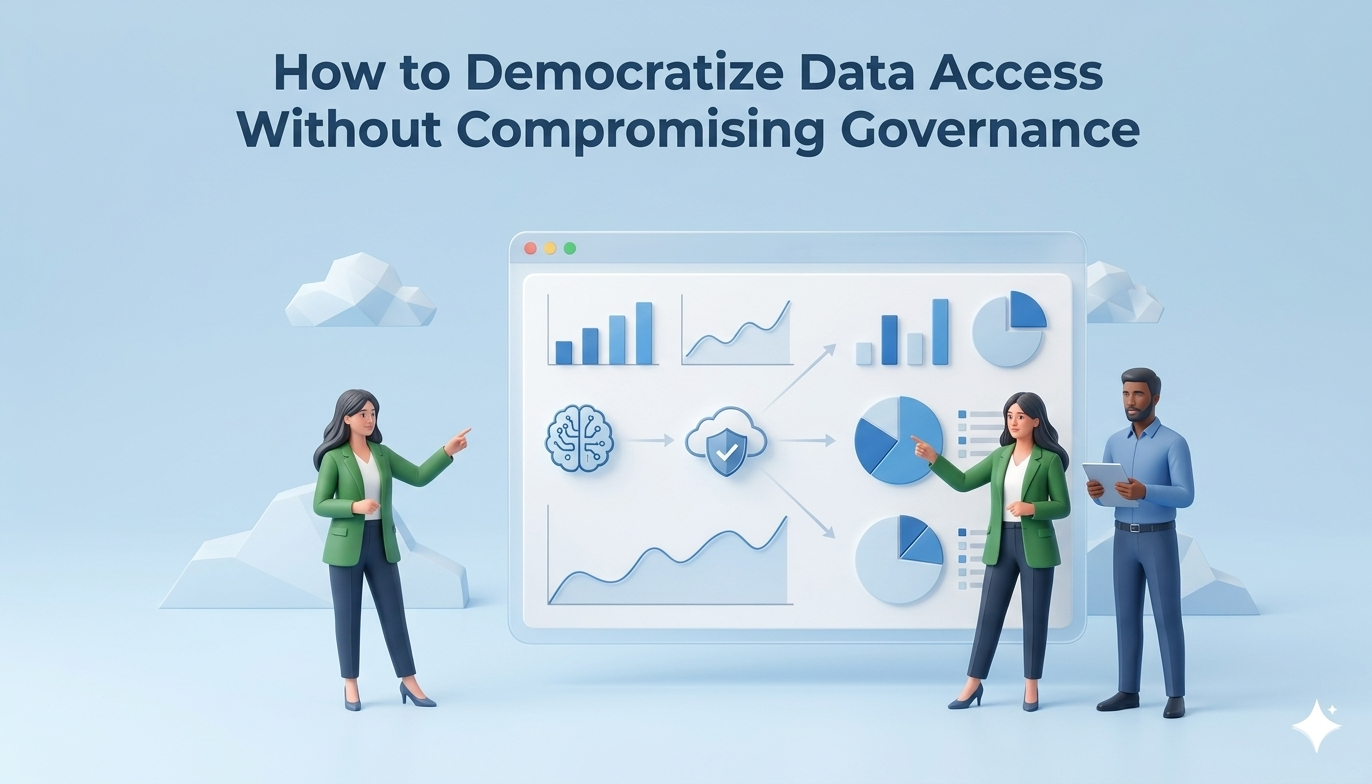
How to Democratize Data Access Without Compromising Governance
Your analyst needs one number. A question came up in a leadership meeting: which region had the lowest sell-through last quarter, and everyone is waiting. The analyst submits a ticket. Three days pass. When the answer finally arrives, the decision has already been made: someone found a six-month-old CSV in a shared drive, ran their own numbers, and presented a figure that contradicts the one the data team just delivered.
That is not a governance success story. That is governance theater: the appearance of control while the real analytical work happens entirely outside the governed system.
The organizations still framing data access as a tradeoff against governance are solving the wrong problem. Broader access, done with the right architecture, produces more governance integrity than locked-down systems ever did. This article shows you exactly how.
What does it mean to democratize data without compromising governance?
Data democratization without governance is just data chaos. True self-service analytics requires a semantic layer that centralizes KPI definitions, enforces role-based access, and ensures every business user queries the same governed source of truth, regardless of how they ask the question. The goal is not to give everyone access to everything; it is to give the right people access to the right data, every time, through a system that makes the governed path the easiest path.
The Real Governance Failure Is Not Broad Access, It Is Unstructured Access
Most data governance conversations start in the wrong place. Teams assume the risk is that too many people can see too much data. The actual risk is that people who need data cannot get it through governed channels, so they build their own routes around them.
There are four specific failure modes that create governance breakdown in practice. Metric sprawl happens when teams build separate dashboards with slightly different definitions of the same KPI: revenue by booking date in one, by invoice date in another. CSV exports move data permanently outside every access control, audit log, and version history the data team built. Shadow analysis produces conflicting numbers that erode organizational trust in data-driven decisions. And access expands incrementally, without consistent controls, until no one has a complete picture of who can see what.
These failures share a common cause: they are workarounds. People do not export CSVs or build shadow dashboards because they want to undermine governance. They do it because the governed system is too slow, too technical, or too opaque to answer their question before the meeting starts.
Locked-down systems do not prevent these workarounds; they create the conditions for them. A data access approach that prioritizes restriction over usability will always produce ungoverned behavior at the edges.
The solution is not tighter restrictions. It is a governed layer that business users actually want to use.
Why Traditional Approaches Create the Tradeoffs They Are Trying to Avoid
The standard playbook for enterprise analytics has not changed much in a decade: build more dashboards, run more training sessions, hope that business users eventually stop asking the data team for help. It rarely works. Each tool added without a shared definitional layer compounds the problem rather than solving it.
More Dashboards, More Metric Sprawl
Consider a scenario that plays out in enterprise organizations every week: two teams present revenue figures in the same leadership meeting and arrive at different numbers. Neither team is wrong. One pulled revenue by booking date; the other used invoice date. Each dashboard had its own filter logic, its own date range assumption, and its own implicit definition of "revenue." The conflict is not a data quality problem; it is an architecture problem. There is no single place where "revenue" is defined.
Dashboard proliferation makes this worse with every new report built. Without a semantic layer enforcing a shared definition, each new dashboard is another opportunity for metric drift.
CSV Exports Are Where Governance Goes to Die
The moment a CSV file lands on someone's desktop, it has left every governed system the data team built. No access controls. No audit log. No version history. No guarantee the schema matches current production data. The file will be forwarded in email, pasted into a presentation, and shared in a Slack channel before the week is out.
This is the most common governance failure in enterprise analytics, and it is almost never treated as a governance failure. It is treated as normal workflow. The question is not whether your organization has this problem; it is how often it happens and whether anyone is tracking it.
Shadow Analysis and the Conflicting Definition Problem
When two teams cannot agree on a number, the problem almost never lives in the data itself. It lives in the absence of a shared definition layer. Every conflicting metric in a leadership meeting is a tax on organizational confidence in data-driven decisions. Leaders begin to distrust reports. Analysts spend time reconciling instead of analyzing. The data team, which built all of this infrastructure, gets blamed for numbers they never produced.
None of these problems are solved by adding more dashboards or more training. They are solved by ensuring every query, regardless of who runs it or how, resolves against the same governed definition.
What True Democratization Actually Requires
Self-service analytics fails when organizations treat it as a distribution problem: get the dashboards to more people, run the training, open the access. It works when organizations treat it as an architecture problem: build one governed layer that every access method sits on top of.
That layer is the semantic layer. And its governance function is the reason broad access and data integrity become compatible rather than competing.
The Semantic Layer as Governed Source of Truth
A semantic layer is where business logic lives. It is where "revenue" gets defined once, with its exact date field, its currency normalization logic, and its regional rollup rules, and that definition is then enforced for every query, regardless of who asks or what tool they use. KPI definitions, table relationships, and data hierarchies are centrally managed and version-controlled.
The contrast with dashboard proliferation is stark. Instead of twelve dashboards with twelve slightly different revenue definitions, there is one semantic layer with one definition. An analyst asking via SQL, a business user asking in natural language, and an automated report scheduled for Monday morning all receive answers grounded in the same logic. Metric drift becomes architecturally impossible.
This is the foundation that makes governed self-service analytics real rather than aspirational.
Role-Based Access That Travels With the Data
Governance controls that live at the dashboard level break the moment users bypass the dashboard. Controls that live at the semantic layer hold regardless of access method. Role-based access controls aligned with existing warehouse permissions mean that a regional sales manager in Southeast Asia sees only Southeast Asia data, whether they access it through a scheduled report, a custom query, or a natural language question typed into a chat interface.
Knowledge-based filters extend this further: data can be segmented by team, region, or business unit at the semantic layer itself, so the governed boundary is not just who can log in, but what each user can see once they are inside. Access expands. Governance holds.
Security Built In, Not Bolted On
The most common objection from data engineers and information security teams when evaluating AI analytics tools is a reasonable one: does this require our data to leave our environment? For most cloud-based analytics platforms, the answer is yes. Data is replicated to an external system where queries are processed.
Lumi AI's gateway architecture inverts this. Raw data computation occurs on the client's own systems. The AI layer interacts with the semantic description of the data, not the data itself. There is no replication to external environments, no deviation from existing data residency requirements, and no new surface area for a breach. The platform's enterprise-grade security model, including its SOC 2 Type I certification achieved in July 2025, reflects this architectural commitment rather than compensating for its absence.
This distinction matters when governance is the goal. Security bolted on after deployment means the governance model was designed without security. Security built into the architecture means governance and security are the same investment.
Conversational Analytics as a Governance Enforcement Mechanism
The counterintuitive argument that most governance frameworks miss is this: a natural language interface, when grounded in a governed semantic layer, enforces governance more consistently than traditional BI tools, precisely because it eliminates the unstructured workarounds that are the actual failure modes.
With Lumi AI's conversational analytics, a business user asks a question in plain English. The platform translates that question against the curated knowledge base, resolves it against centrally managed KPI definitions, and returns an answer grounded in the governed reporting layer. There is no raw table access. No ad hoc joins against unverified schemas. No metric drift introduced by a new filter assumption. The conversational interface becomes the governed channel, not a bypass around it.
Return to the scenario that opened this article. The analyst needs a number before a leadership meeting. In the old model, that requires a ticket, a three-day wait, and a result that may or may not match what a colleague found in a shared CSV. With a governed conversational layer, the analyst types the question, gets the answer in seconds, and both the answer and the query are auditable. The workaround is no longer necessary because the governed path is now the fastest path.
When the governed channel is also the most convenient channel, governance becomes self-reinforcing rather than something that has to be policed.
The Governance ROI Argument
Every organization that has tried to implement self-service analytics has run into the same organizational friction: the data team sees governance as infrastructure investment, and leadership sees it as delay. The ROI argument for governance is usually framed around risk reduction, which is true, but not motivating.
The more accurate frame is this: the investments required to enable governed self-service analytics are the same investments that produce compounding returns as query volume grows.
Four investments produce governance ROI. Building a structured knowledge management layer forces the organization to document its own business logic, work that pays dividends in onboarding, audits, and regulatory compliance. Defining KPIs clearly eliminates the reconciliation cost that conflicting metrics impose at every leadership meeting. Curating a semantic reporting layer creates a versioned, auditable record of how the organization defines its own performance. Aligning access controls with business roles means governance scales with headcount rather than requiring manual administration with every new hire.
The Chalhoub Group identified sixty million dollars in additional revenue opportunities using Lumi by surfacing insights from governed sales data. GROWMARK, a leading agricultural cooperative, used Lumi to replace a fragmented reporting environment that relied on tribal knowledge, and enabled statistical analysis that previously required in-house data scientists. In both cases, the governance investment enabled the insight. The insight did not happen despite governance; it happened because of it.
Instead of governance being a compliance checkbox, it becomes the foundation that enables scalable AI-driven analytics. When the knowledge base, KPI definitions, and semantic layer are in place, every new query, from every new user, draws on governed infrastructure that was already built. The marginal cost of access approaches zero. The marginal governance risk approaches zero with it.
Frequently Asked Questions
What is the difference between data democratization and ungoverned data access?
Data democratization is structured, role-aware, definition-consistent access for non-technical users. Ungoverned data access is broad access without a semantic layer, which produces metric sprawl, conflicting definitions, and shadow analysis. The former enables better decisions at scale. The latter makes organizational trust in data progressively harder to maintain. The difference is entirely architectural: democratization requires a governed foundation; ungoverned access ignores the need for one.
How does a semantic layer prevent metric sprawl and shadow analysis?
A semantic layer centralizes KPI definitions and table relationships so every query resolves against the same governed definition, regardless of who asks or what tool they use. Metric sprawl occurs when definitions drift across dashboards built without a shared source of truth. Shadow analysis happens when users cannot get answers through governed channels fast enough and build their own routes around them. A semantic layer makes definition drift architecturally impossible and makes the governed channel fast enough to use.
Can business users get self-service analytics without sensitive data leaving our environment?
Yes. With a gateway connection architecture (the approach Lumi AI uses), raw data computation occurs on the client's own systems. The AI layer interacts with the semantic description of the data, not the data itself. No replication to external environments. No deviation from existing data residency requirements. This is the distinction between security built into the architecture and security bolted on after deployment.
Why do traditional BI approaches keep producing governance problems even after significant investment?
Traditional BI tools are built around dashboards, not definitions. Each dashboard can encode its own version of a KPI. Each new report is a new opportunity for metric drift. Without a semantic layer enforcing shared definitions, governance depends on human discipline rather than architectural constraint, and human discipline does not scale. The governance investment that pays off is the one that makes the governed path the easiest path, not the one that makes ungoverned behavior harder.
How long does it take to implement a governed self-service analytics layer?
Implementation timelines depend on the complexity of the data environment, but Lumi AI is designed for rapid onboarding, with enterprise clients up and running within a week. The core implementation work is building the knowledge base and semantic layer: documenting business logic, defining KPIs, and mapping table relationships. This is work that produces governance ROI independent of the analytics platform and compounds in value as query volume grows.
The Governed Path Should Be the Fast Path
The analyst who needed a number before the leadership meeting should not have to choose between speed and governance. With a governed conversational analytics layer, speed and governance are the same thing. The question gets answered in seconds. The answer is grounded in a centrally managed KPI definition. The query is auditable. The data never left the secure environment.
That is not a vision of future infrastructure. It is what organizations that have made the right architectural investments are operating today. The Chalhoub Group, GROWMARK, and Kroger did not compromise governance to get faster insights. They built governance into the layer that makes fast insights possible.
The data democratization question is not whether to give business users access. It is whether the access you give them makes them more or less likely to build workarounds. The answer determines whether your governance investment pays off or gets quietly circumvented every time someone has a question and a deadline.
See how Lumi AI's governed semantic layer works in practice. Book a demo.

Data & AI Products | Founder & CEO at Lumi AI | Ex-Director at Unicorn. Ibrahim Ashqar is the Founder and CEO of Lumi AI, a company at the forefront of revolutionizing business intelligence for organizations with a specialization in the supply chain industry. With a deep-rooted passion for democratizing data access, Lumi AI seeks to transform plain language queries into actionable business insights, eliminating the barriers posed by SQL and Python skills.
Related articles
The New Standard for Analytics is Agentic
Make Better, Faster Decisions.